The over-hyped(?) ark of AI

Cathie Wood’s team at ARK Invest has published their Big Ideas 2024. The slide deck is interesting throughout.

But,

Do any serious people seriously believe this?

That AI can accelerate global real GDP growth from 3% to 7%?

That seems wildly optimistic, even in techno optimist circles.

Compare that to the more sober assessment from PwC’s oft-cited report, that AI can add $15,7 trillion to the global economy by 2030. Given that global GDP today is approximately $100 trillion, that is approximately another 15% on top.

Alternativ Nyttårstale

Når regnskapet for 2023 skal gjøres opp er det klart at «vanlige folk» ble sittende med svarteper. Det er ikke første gang og neppe siste.

Det er ingen grunn til å forvente at 2024 vil bli bedre. Velgere i vestlige land må stille seg bak minimum tre interessegrupper når politikerne fordeler nasjonenes velstand.

  1. Evighetskriger
    • Senest i Ukraina, der NATO-landene har gått hodestups inn i en konflikt mot Russland, uten noen strategi for å vinne eller komme seg ut av den. Motivet kan være både edelt og nobelt, men det betyr ikke at misjonen vil lykkes. I første halvår var nyhetene fylte av proklamasjoner om at Ukrainas våroffensiv ville feie de russiske styrkene ut av ukrainsk territorium. Mens Putins krigsmaskineri visstnok var på randen av sammenbrudd.
    • Den gang ei. Storoffensiven materialiserte seg aldri. Og Russlands hærstyrker gjorde som de har gjort i tidligere kriger, trosset spådommer om kollaps og vist standhaftighet og seighet som har overrasket vestlige Eksperter. På slutten av året har tonen i overskriftene endret seg, og NATO-generalsekretær Stoltenberg har advart om «bad news» i vente fra den ukrainske fronten.
    • I 2023 har vestlige lands støtte til Ukraina beløpt seg til 35 milliarder dollar. Siden krigens start har støtten fra EU-landene nådd 85 milliarder euro, mens støtten fra USA har oversteget 75 milliarder dollar.
    • På begge sider av Atlanteren møter de hittil ubegrensede kredittkortene voksende politiske og konstitusjonelle hindringer. Det ufravikelige faktum er at skalaen på NATO-landenes støtte til Ukraina mangler demokratisk forankring.
    • Vestlige ledere gjentar til stadighet at Ukrainas territorielle suverenitet må bevares. Faktum dog, er at det i 2024 vil være ti år siden Russland annekterte Krim. Om en skal forholde seg til virkelige forhold er ergo et suverent Ukraina et forlengst forbigått kapittel. Med økende folkelig motstand mot vestlig innblanding i konflikten vil denne virkelighetserkjennelsen sakte synke inn også blant vestlige ledere, som ikke vil ha mulighet til å kjempe til siste ukrainer om de har mistet sin siste hjemlige velger.
    • Stoltenberg fremholder at jo mer støtte Vesten gir til Ukraina, desto fortere vil konflikten ende. Han er formodentlig programforpliktet til å si dette, men det har ingen basis i virkelighet.
    • Drømmen om en ukrainsk seier er intet annet enn ønsketenkning, som ingen er tjent med. Men vestlige leder vil etter alt å dømme fortsette å gjenta dette fantasifulle budskapet helt til de, i 2024 eller senere, trekker seg ut i hui og hast med halen mellom bena som fra Kabul i 2021, eller fra Saigon i 1975.
  2. Det grønne skiftet
    • Da Bismarck ble spurt hvorfor han ikke var mer opptatt av å skaffe Tyskland kolonier i Afrika, svarte han med sedvanlig bravado: «Her er Russland, her er Frankrike, og her i midten, ligger vi, Tyskland. Det er mitt kart over Afrika!» I motsetning til dagens folkevalgte politikere hadde Bismarck evnen til å tenke strategisk. Han ville snudd seg i graven av at hans etterkommere var dumme nok til å gå til krig mot Russland, uten å ha et klart alternativ til energiforsyningen fra nettopp Russland—som Europa hadde gjort seg avhengig av.
    • Norske husholdninger og bedrifter har fått lide under skyhøye strømpriser, takket være den politiske beslutningen om å hyperkoble det norske strømnettet sammen med det europeiske. For hver dårlige beslutning av Angela Merkel i Tysklands Energiewende har norske husstander måttet betale.
    • En velkommen konsekvens av høye renter er dog at en del grønne luftslott er blitt avslørt som nettopp det. Vestlige politikere og medier har blitt tvunget til en erkjennelse av at man ikke kan subsidiere seg frem til et karbonfritt nullutslippssamfunn.
    • Likefullt må en forvente at politikere vil fortsette å la seg forføre av dresskledde direktører med fantastiske planer om havvind og banebrytende batterifabrikker.
  3. Masseinnvandring
    • Idet innvandringsregnskapet gjøres opp ligger det an til at 2023 vil tangere kriseåret 2015 i antall nyankomne flyktninger til Europa, da 1,35 millioner søkte asyl i Europa. Inn i det nye året fortsetter folkevandringen fra Midtøsten og Afrika til Europa i uforminsket styrke. Krigen i Ukraina og situasjonen i Gaza må forventes å bidra til ytterligere tilstrømming.
    • I ettertid er det klart at 2015 ikke representerte noen unntakstilstand, men snarere en ny normal. En permanent masseinnvandringskrise.
    • Den politiske viljen til å gjøre noe med situasjonen er fullstendig fraværende, selv blant partier på høyresiden. I Italia har Giorgia Melonis eksempel vist at en høyrepopulist kan vinne valg på en plattform mot innvandring. Men straks regjeringskontorene inntas er alle lovnadene fra valgkampen enten glemt eller bortforklart, og innvandringen slår stadig nye rekorder—opp over 50 prosent til over 155.000 i året som gikk.

Europeiske politikere har et skyhøyt—for ikke å si utopisk—ambisjonsnivå for Europas evne til å føre krig mot Russland i Ukraina, i parallell med et fantasifullt grønt skifte, samtidig som at kontinentet forventes å kunne absorbere en endeløs strøm av uintegrerbare flyktninger fra den tredje verden.

Når den politiske eliten går så høyt ut på banen skulle en tro at bakteppet var en sterk økonomi og sosial harmoni på hjemmebane. Sannheten er den rake motsetning. Europas sklerotiske økonomi er i stagnasjon—med nullvekst i bruttonasjonalprodukt. Folks lønninger holder ikke tritt med prisveksten. Med utfasing av fossile energikilder og skyhøye strømpriser må millioner av husstander fryse gjennom vinteren. Samtidig som masseinnvandringen fortsetter å tære på det sosiale limet i samfunnet.

I Norge fikk vi det illustrert i julen da en innvandrerungdom knivdrepte en 26 år gammel krigsflyktning på bussen i Bærum lille julaften, uten at noen så mye som hever et øyenbryn. Hendelser som for bare 10, eller til og med fem år siden ville vært sensasjonelle, er blitt dagligdagse.

Bakteppet for Europas storsatsning på idealistisk krigføring, grønn energitransisjon og multikulturell masseinnvandring er med andre ord temmelig dystert, om ikke direkte dystopisk. Dette er ikke lenger Europa fra 100 år siden, med en ung og vital befolkning, kulturelt enfold og økonomisk styrke. Dette er et gammelt og grått Europa. Med en gammel og grå politisk elite, med stormannsgale visjoner og politisk vilje ute av proporsjon med kontinentets, og folkets, politiske evne.

Samtidig er den politiske eliten, massestrømsmedia og det statlige skolevesenet på god vei til å helt og holdent frastøte seg den demografiske gruppen som er mest avgjørende for Europas fremtidige ve og vel, nemlig unge menn.

At stadig flere unge menn ikke lenger identifiserer seg meg, eller føler seg investert i det politiske prosjektet Europa, burde være dypt foruroligende. Det er de som er morgendagens gründere og skattebetalere. Politikere kan dagdrømme om en fremtid der nye bedrifter blir skapt av kvinner og flyktninger, men det vil aldri bli mer enn unntakene, og aldri i nærheten av nok til å kunne bære morgendagens oppsvulmede velferdsstat.

Politikere og prateklasse burde derfor ikke ta så lett på å avfeie og latterliggjøre unge menns legitime og høyst berettigede bekymringer. Istedenfor å lese Jordan Peterson eller Andrew Tate som fanden leser bibelen, burde man søke å forstå hvorfor deres budskap får større gjenklang hos gutter, enn indoktrineringen som serveres i skolen og fra medias liberale kommentariat.

Kombinasjonen av to motstridende grupper unge menn; vertsbefolkningens gutter som føler seg frastøtt og den nye befolkningens gutter som ikke kan assimileres i et åpent og liberalt samfunn, er naturligvis eksplosiv. Europa har blitt en kruttønne og politikerne leker med fyrstikkene. De burde vokte seg vel, om de ikke skal bli hjemsøkt av Vergil, og Enoch Powells ord:

«Når jeg ser fremover, blir jeg fylt med bange anelser; i likhet med romeren ser jeg elven Tiber skumme av blod.»

Godt nytt år!

Støres store «Vi»

«Det konkrete politiske skillet som politiske handlinger og motiver kan reduseres til, er skillet mellom venn og fiende.»

Det sa den famøse tyske juristen Carl Schmitt.

Schmitts postulat er problematisk. Ikke fordi påstanden er usann, men fordi den er sann. En ubehagelig sannhet.

Statsminister Jonas Gahr Støre, i sitt tilsvar til Karpe Diems Magdi Abdelmaguid, maner derimot til å tro på et større «vi». I motsetning til Magdi, som uten å sitere Schmitt, ikke lenger identifiserer seg med Støres «vi».

Mange (til og med sedvanlig Støre-kritiske stemmer) har latt seg røre av Støres tekst. Jeg vil snarere si Støres tekst er røre. Full av patos, men svak på logos.

Mens Schmitt var en mester til å konkretisere det abstrakte, trives Støre best blant abstraksjoner og vegrer seg for det konkrete.

Krigen som nå utspiller seg i Midtøsten krystalliserer skillet mellom Hamas og Israel, mellom venn og fiende. Fiendskapet mellom jøder og palestinere har ligget latent i over 1000 år. Etter 7. oktober har konflikten atter en gang blusset opp, antagonismen har nådd sitt mest intense, og det mest ekstreme politiske middelet, krig, har blitt tatt i bruk som en eksistensiell negasjon av fienden.

Støres ord, om at «Dypest sett, så er verden også et «vi»; i stadig sterkere grad knyttet sammen», blir da meningsløse. Hamas og Israel er ikke del av et felles «vi». Tvert om er sannsynligheten for fredelig sameksistens mellom Israel og palestinerne mindre enn noen gang. Det er rett at «vi» alle trekkes inn i konflikten. Men ikke «vi» som en felles politisk enhet, men på en side av «oss» mot «dem»—slik man da også ser at diskursen om konflikten har hardnet til i Norge, tilsynelatende langt fra konfliktens episentrum.

Som sådan treffer Magdis virkelighetsbeskrivelse langt mer presist enn statsministerens: «Hver eneste bombe som slippes over Gaza, skaper en dypere kløft i Europa, og snart står vi på hver vår side av krateret og ser ikke lenger verden fra samme sted.»

Støres store «vi» er intet mer enn en selvmotsigende abstraksjon. I den ene setningen sier han at alle i verden er del av et globalt «vi». I den neste sier han at: «Du og jeg, med ulik familiehistorie, har ulike minner, men nok felles til at vi både kan snakke om og ta ansvar for et «vi» i Norge.» Hvis det finnes et norsk «vi», så følger det nødvendigvis derav at det også finnes et «dem» som ikke er norsk.

Som Schmitt sa: «Den politiske enheten forutsetter den reelle eksistensen av en fiende og derfor sameksistens med en annen politisk enhet.» Den politiske enheten Norge oppstod og eksisterer i opposisjon til territoriene rundt seg som ikke er norske. I dag nyter Norge fredelig sameksistens med sine naboland. Men det hører med til saken at svenskene og danskene, landene som ligger oss nærest, historisk også har vært våre argeste fiender—akkurat slik israelerne og palestinerne finner fiendskap i naboskap.

Vi definerer det norske mot det ikke norske, ikke nødvendigvis fiendtlig, men annerledes. De fleste nordmenn, med Støre som unntak, kan relatere seg mer til et norsk «vi», enn et europeisk eller globalt «vi». Jo mer globalt og abstrakt man definerer et «vi», desto svakere og mer meningsløst blir det. Det er heller ikke slik at det ikke finnes antagonisme mellom Norge og naboland. Men der israelerne og palestinerne tyr til raketter og maskingevær, nøyer vi oss med svenskevitser og langrennsstafett.

Støre ramser videre opp de egenskapene som han mener «binder oss sammen i et «vi» i Norge; som menneskeverd, likeverd, demokrati, ytringsfrihet, religionsfrihet og tillit.» Felles for alle disse størrelsene er at de har blitt svekket av det større «vi» som masseinnvandringen til Norge har gitt.

Det blir også bare tullball når Støre benekter at den pågående konflikten i Midtøsten ikke er en krig mellom religioner, noe det i aller høyeste grad er. En slik realitetsbenektelse er ingen tjent med. Joda, jødedommen, kristendommen og islam har flere ting til felles. For eksempel at de alle er monoteistiske religioner, og som sådan gjensidig utelukkende. Kristendommen skilte seg fra jødedommen for 2.000 år siden og Muhammed gikk sin egen vei for snart 1.400 år siden, og det faktum at alle tre har sine helligste steder i Midtøsten er mer en kilde til konflikt enn forsoning og fellesskap.

Konflikten mellom Israel og Hamas er en religiøs konflikt mellom jødedom og islam. Det er også en konflikt mellom Iran og Israel, og i forlengelse en konflikt mellom Vesten og Iran, mellom kristendom og Islam. Hva Støre mener konflikten er forblir tåkelagt.

Statsmannen Støre ser seg som alltid forpliktet til å nyansere. Dette er tross alt den samme Støre som løy om at han hadde holdt hemmelige samtaler med Hamas.

I likhet med Magdi ser ikke jeg lenger behovet for eller verdien av nyanse. Jeg står urokkelig på en side av kløften, bare motsatt side av ham.

For meg er valget enkelt. Sivilisasjon eller barbari. Da velger jeg sivilisasjon. Den amerikanske filosofen Sam Harris har kokt spørsmålet ned til essensen. Hva ville hver av partene ha gjort hvis de hadde makt til å gjøre hva de ville? I begge tilfeller vet vi svaret. Israel har overlegen militærmakt og bruker den i så begrenset omfang som mulig, og gjør alt i sin makt for å skjerme sivile—på begge sider. Hva ville Hamas gjort? Det fikk vi svaret på den 7. oktober, da Israels vanligvis vanntette forsvar sviktet. Rundt 1.200 mennesker ble drept, hvorav hundrevis ble torturert, lemlestet, paradert og likskjendet på de med bestialske vis. Å holde Hamas og Israel som moralske ekvivalenter er derfor en synd.

Israel kunne Norge hatt et felles «vi» med, slik de to landene i etterkrigstiden hadde et godt og nært forhold. Med Hamas vil det alltid være «dem» og «oss». Mange nordmenn, de fleste på venstresiden og forbausende mange feminister har ikke nølt med å ta palestinernes side, og har gått langt for å rasjonalisere og bortforklare Hamas’ terrorhandlinger. Sympatien er neppe gjensidig. Om de hadde havnet i Hamas´ hender, ville de vært heldig om de slapp fri med hodet i behold. I motsetning til den tyske kvinnen Shani Louk, som mange på sosiale medier først argumenterte for at var i live og bare lå i en litt keitete positur på lasteplanet til en gjeng ganske ålreite karer fra Hamas. Den gang ei.

Bedømt fra oppmøte i gatene i europeiske storbyer og amerikanske college-campuser så er det en voldsom folkelig støtte for Hamas i Vesten i dag, især blant den delen av befolkningen med bakgrunn fra muslimske land. Ironisk nok har mange flyktet fra den type regimer som de nå bejubler, på trygg avstand. Om de utgjør flertallet av befolkningen er lite trolig. Men det er ihvertfall en veldig vokal minoritet. Jødiske minoriteter derimot, har få allierte og må ligge lavt for å ikke bli lynsjet.

Forrige uke var jeg på vei til middagsselskap i London da jeg selv plutselig havnet midt i en pro-palestinsk parademarsj like ved Piccadilly. «From the river to the sea, Palestine will be free». Hvor skal jødene gjøres av? Denne uken er jeg i Dubai. Et emirat som vel å merke er muslimsk. Her er det ikke et palestinsk flagg å finne noe sted. Ikke én eneste plakat med «Free Palestine» eller at kloden må renses for jøder.

De arabiske landene er ikke hevet over å spille Palestinakortet hvis det gagner dem. Men alt tyder på at emiratene og Saudi-Arabia i realiteten stiller seg likegyldige til palestinernes skjebne. Bevisene på det finner man i at de hverken sender penger eller tar imot flyktninger. Den makten som har interesse av å bruke Hamas og Palestina som proxyer i sin krigføring mot Vesten er Iran. Tyrkia sitter foreløpig på sidelinjen som en joker.

Så Magdis uforbeholdne støtte til palestinerne, og derav de facto Hamas, fremstår for meg som forunderlig og lite reflektert. At mer ekstreme varianter av holdningene hans har stor utbredelse blant den muslimske minoritetsbefolkningen i mange europeiske land er direkte skremmende. For jøder er det ironisk nok blitt tryggere i emiratene enn i Vesten.

Men det jeg kan være enig med Magdi i er at det ikke er noe «vi». Tilspissingen av Midtøsten-konflikten har tydeligggjort venn-fiende-aksen, også i debatten her hjemme. Det er et faktum man ikke kan ønsketenke seg vekk fra, særlig ikke om man er statsminister.

End Times

I have been End Times by Peter Turchin, finding it to be one of the most compelling political science books I’ve come across in quite some time.

Turchin is a pioneer in the field of Cliodynamics, having made a mid-career shift from theoretical biology with the aim of applying complexity science, vast databases and more scientific rigour to the study of history.

Prior to a recent mention in a Bloomberg article by Niall Ferguson on the new Sino-American Cold War, I was not familiar with Turchin’s work. For the purpose of this discussion, I will focus solely on “End Times” and not delve into his other works.

In “End Times,” Turchin highlights a significant and in my mind the most under-communicated challenge facing Western (and fot that matter Eastern) societies: Elite overproduction. Western societies have long prided themselves on meritocracy, where individuals can rise from humble origins to positions of power and prominence through the pathway provided by the education system. The traditional aristocracy and clergy have been largely replaced by a credentialed class.

However, a problem arises when there is an excess of elite aspirants graduating into a stagnating economy. Turchin’s extensive historical database reveals that such circumstances, coupled with widespread popular immiseration and record income inequality, inevitably lead to crises. Remarkably, Turchin predicted well in advance that the 2020s would become a period of political instability.

Unfortunately, historical evidence shows that finding a smooth exit from a crisis of elite overproduction is challenging, with only a few exceptions such as the reform acts in Victorian Britain and the New Deal period in the US. Typically, the surplus elites must be culled, either non-violently or, if necessary, through violence.

While Turchin doesn’t explicitly predict how or if Western societies will escape the predicament of an increasing number of credentialed aspirants seeking to join an increasingly gerontocratic elite that controls an ever-growing share of the wealth of economies which lack the dynamism and growth potential of the past, he is not optimistic in the near term.

Turchin’s concept of Elite overproduction should serve as food for thought for policymakers who still adhere to the previous success formula of pushing as many students as possible through the higher education assembly line without fully considering the consequences when these aspiring elites realise their prospects of joining the elite may not align with reality.

Where was Michael Lewis?

If Michael Lewis was indeed embedded with SBF for 6 months, that raises a number of questions:

A) did he see through the Ponzi?
B) if so, why didn’t he break the story?
C) would it be ethical to stay silent if he knew, in order to gather a more explosive story/book sales?
D) or did he actually see SBF as Skywalker vs CZ as Vader?

Media reports seem to point towards D), which would not exactly cast Lewis in a flattering light. Did he too drink the FTX Kool-Aid?

Silver linings of the Crypto Crash

Crisis may ultimately reveal that the supply of Bitcoin is scarcer than it appears.

The tragedy of the current “Crypto” crisis is that Bitcoin is being punished for the sins of SBF — never mind that the demise of FTX does not in any way discredit the value proposition of Bitcoin. On the contrary, FTX was everything Bitcoin is not.

The crisis has triggered a wave of margin calls, liquidations and panic selling, sending the Bitcoin price sharply lower. That is a natural first-order effect, as people question the merits of cryptocurrencies and declare the death of Bitcoin.

There is widespread belief that a cascading crisis will trigger a flood of further Bitcoin liquidations, as exchanges, lenders and funds fail one after another. But how much further can it go?

3AC, Voyager, Celsius and now FTX/Alameda are all in or entering liquidation. But what they all have in common — contrary to what the layperson would intuitively believe about crypto companies — is that they all hold preciously few bitcoins on their balance sheets.

It is staggering that FTX listed 0 bitcoin on its balance sheet, against $1,4 billion of bitcoin liabilities. But, what that obviously means is that there will be no bitcoins to auction off from the ashes of FTX.

3AC was estimated to have around $4 billion worth of assets when it went bankrupt in April — at current market prices it may be half the value or less now.

I don’t know the composition of the 3AC’s remaining assets. But what is sure is that 3AC did not possess the 15,250 bitcoins it owed to Voyager, which in turn sent that firm down:

Pursuant to the 3AC Loan, Voyager agreed to lend 3AC 15,250 Bitcoins and 350 million USDC; 3AC drew down on the entire 3AC Loan. After the Luna crash in 2022, Voyager initially requested partial repayment of the 3AC Loan, and subsequently requested full repayment by June 27, 2022. 3AC did not honor either repayment request. 3AC’s nonpayment, among other things, resulted in Voyager filing its own chapter 11 case in the United States Bankruptcy Court for the Southern District of New York on July 5, 2022.

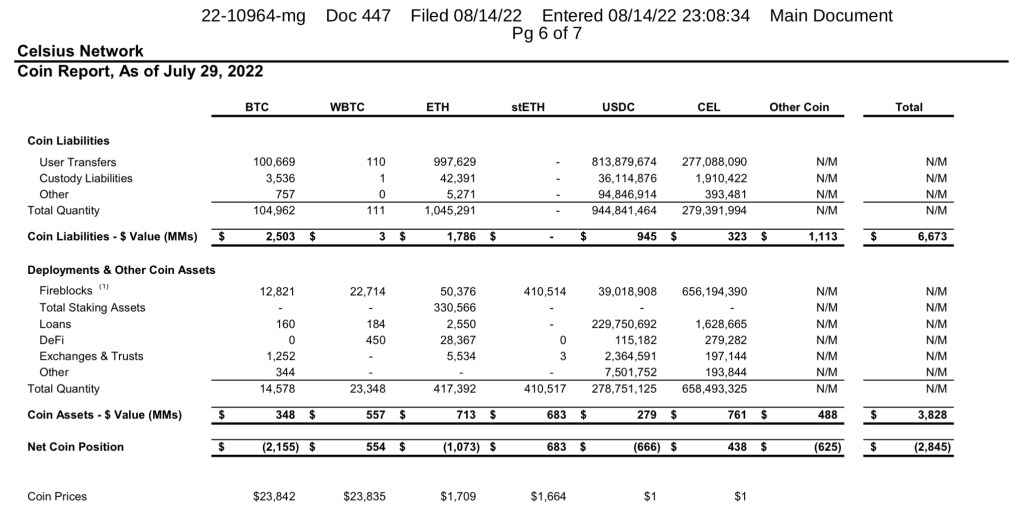
That is quoted from the bankruptcy filing of Celsius, the week after Voyager went down. Celsius’ original filing on July 14th listed a $1,2 billion gap between assets and liabilities. By August that gap had widened to $2,8 billion, as the value of assets fell and liabilities swelled.

A court filing in August showed that Celsius held only 14,578 BTC (~$250m at current prices), (+ 23,348 wrapped bitcoins, for whatever they will be worth), against 104,962 BTC (~$1,75b at current prices) that it owes to clients and creditors. The result of this is of course that people own way less actual bitcoins than they believed they owned.

On Nov. 10th Celsius filed a motion to extend the exclusivity period to work out its own reorganisation plan. So it remains unclear what will happen to the failed lender’s [smallish] stack of Bitcoin, but it is unlikely to unleash huge selling pressure on the market when Celsius’ assets are auctioned off.

On Nov. 11th Voyager announced that it is reopening the bidding process for its assets, now that the “$1,4 billion” sale to FTX is of — or $51 million, which was the actual amount of cash to be paid. What will happen with BlockFi, which was also supposed to be taken over by FTX, is also up in the air again. I don’t have the exact figures, but it appears unlikely that any of these companies hold more bitcoins on the asset side than the liability side of their balance sheets.

Of course the crisis may continue to cascade and engulf other players. Crypto.com appears to be next in line for a run on the bank. Crypto.com holds approx. $800 million worth of Bitcoin, according to Nansen, around a third of its total digital coin holdings. Further rounds of forced bitcoin selling can absolutely not be ruled out.

Still, it appears (with provisos of course) that the end result of the domino of falling crypto companies will not be too flood the market with bitcoins, but rather to demonstrate that the supply of actual bitcoins in circulation is much scarcer than the fractional reserve operations of FTX and the other ponzis have given the impression of. That may ultimately turn out to be the silver lining of the crypto crisis.

FTX saga continues

SBF says mea culpa. But obviously believes CZ was never serious about going through with acquiring FTX:

Echoing the contents of his leaked messages from FTX’s Slack earlier in the day.

One might ask why SBF is tweeting throwing stones in glass houses, instead of speaking to lawyers — especially given that most of his legal and compliance team has reportedly quit.

Reportedly SBF is still looking to raise money. With Dan Loeb mentioned as one potential taker. Though the fundraising efforts may be complicated by the fact that Bahamas regulators have frozen FTX’s assets.

On the one hand, even if FTX needs upwards of $8 billion to fill the gaps, which presumably would give the new investors 100% ownership, that would be a lot lower than the $32 billion FTX was valued at earlier this year. On the other hand the business was probably never inherently worth $32 billion, and especially not after what now has transpired.

But it may be too soon to write off FTX entirely yet. One can see a rational for vulture investors to enter the fray.

Meanwhile, Tyler Cowen is pointing out that “the future of crypto exchanges and the future of crypto assets are very different things” — a crucial distinction that have mostly been missed in the media coverage of the FTX debacle, with the likes of Jim Cramer being very quick to declare that the fall of FTX means the death of Bitcoin.

Cowen also speculates that the market for crypto exchanges might evolve into a natural monopoly over time — with Binance looking like the obvious monopolist following FTX’s demise.

It is also true that a dominant clearinghouse is much easier to regulate, and indeed modern central banks often sprung out of these earlier clearinghouse arrangements. Sooner or later, there is a tendency for the law to intervene and turn the dominant private clearinghouse into part of a more formalized central bank.

A future with Binance as the central bank of crypto? It is possible to imagine, even if it would be very far from Satoshi’s original vision.

No deal

Another dramatic turn of events as Binance bailed out from the FTX takeover, citing “news reports regarding mishandled customer funds and alleged US agency investigations”.

SBF is now scrambling to raise $8b to avoid bankruptcy.

With venture funds writing down their stakes in FTX to 0, one wonders what kind of risk-perverse investors would be willing to step in with billions of fresh funding at this point— but never say never in crypto.

Is Justin Sun an unlikely saviour? Or is his purported attempt to find a solution just a publicity stunt?

I wrote yesterday that CZ and Binance had probably passed the point of no return and could not “backtrack now without inflicting even greater collateral damage on Binance and the cryptocurrency industry in general”.

The further steep decline in the BTC price after the news broke of Binance walking away from the deal, proves that point.

That can only mean that Binance’s DD team found a black hole of unimaginable proportions once they started to inspect FTX’s balance sheet, and must have concluded that the risk to Binance of taking over the toxic waste of FTX was greater than the risk of walking away.

Given that CZ was evidently perfectly aware of the collateral damage his backtracking would inflict on the broader crypto market in this fragile hour — as well as the financial markets in general — that speaks magnitudes about how bad the mess at FTX is.

SBF certainly “f—ed up.”

Kryptodämmerung

Only weeks ago Sam Bankman-Fried was hailed as the J.P. Morgan of the cryptosphere, bailing out flailing crypto companies as the industry’s lender of last resort. Now he is the latest Crypto Icarus to have come crashing down to Earth.

SBF’s demise happened at the hands of his rival, Changpeng Zhao or CZ of Binance, who now reigns supreme as the undisputed overlord of the cryptocurrency industry.

While all analysis at this stage is speculative, the attack appears to have been straight out of the Art of War textbook. It will surely be the subject of business school case studies in years to come.

The supreme art of war is to subdue the enemy without fighting.

Sun Tzu

The great showdown started on November 6th when CZ tweeted that Binance would liquidate the entirety of its more than $500 million worth of FTT holdings.

The radio silence CZ’s thread was met with from the normally high frequency tweeting SBF was deafening.

The response from Alameda CEO, Caroline Ellison, that the hedge fund would happily buy back Binance’s stack of FTT @22$ was probably meant to inspire confidence. Instead it smacked of desperation.

At this point the game theorist SBF was caught in his very own prisoner’s dilemma with no way out. Which is somewhat ironic given that SBF and FTX had by all accounts already “betrayed” CZ by lobbying against Binance behind their backs, which CZ referenced in one of his follow-up tweets:

A political decision SBF may well come to rue now that he no longer has the lordly fortune to realize his political ambitions. He of all people must have known that betrayal does not lead to the Pareto optimal outcome in a prisoner’s dilemma? Or did he really believe he could betray Binance without CZ noticing? Or had he read too many of and started to believe all the magazine pieces hailing him as the crypto world’s infallible wunderkind?

More Madoff than Morgan?

The “recent revelations” in CZ’s tweet referred to the Nov 2nd Coindesk report about Alameda Research, which appeared to show that the majority of the net equity of SBF’s trading firm comprised of FTT and other SBF-associated tokens. The rumour mill went into high gear with questions about Alameda’s solvency.

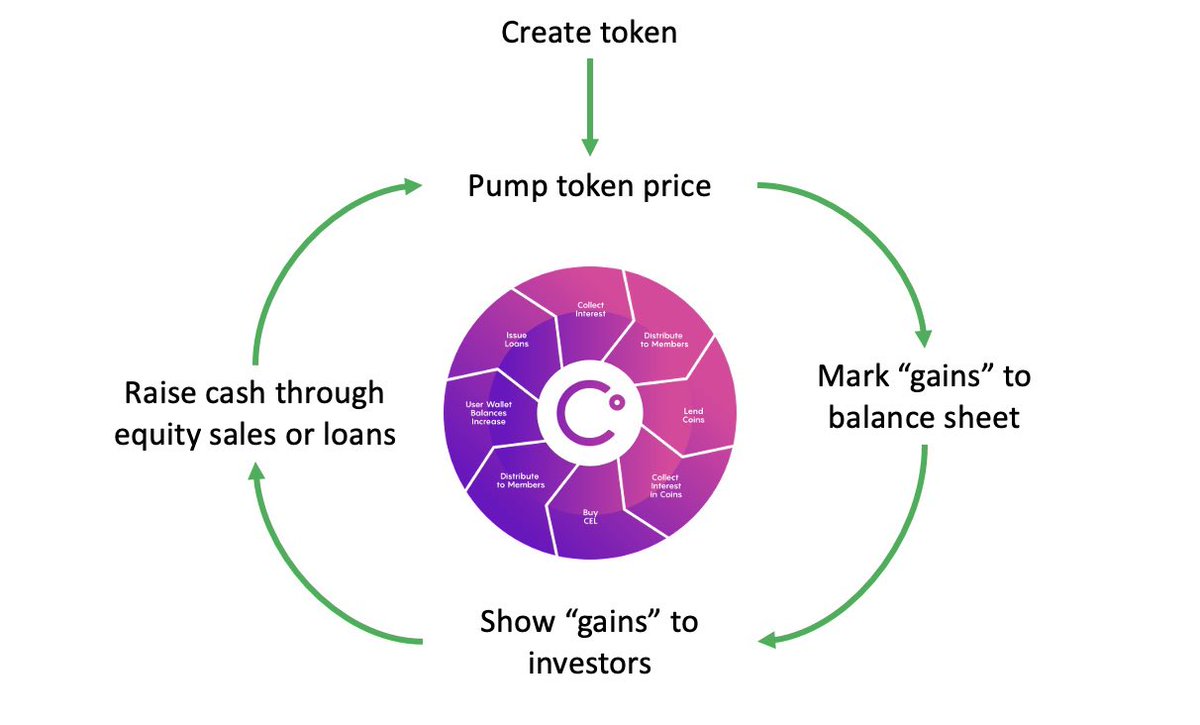
Dirty Bubble Media accused the genius-declared SBF of running precisely the same business model aka ponzi scheme that doomed the crypto lender Celsius Network earlier this year:

Indeed, SBF had raised eyebrows with his cynical description of yield farming schemes on Bloomberg’s Odd Lots podcast back in April. Basically he said that it is little more than black boxes that purport to create money out of thin air. As it turns out it was a fitting description for his own business as well.

It is plausible that CZ was aware of this Achilles heel on Alameda’s balance sheet(?), despite his claims to the contrary.

Having sent out his foreboding tweetstorm all CZ had to do was to sit back and wait for the ensuing bank run on FTX — notwithstanding the collateral damage on the broader cryptocurrency markets.

On Nov 8th SBF was left with no other option than to fold his hand and ask for CZ’s mercy, after client withdrawal requests had clogged up and put FTX in a liquidity squeeze, while the tanking price of the FTT and other SBF-linked tokens had probably rendered Alameda de facto insolvent.

Denouement

The announcement that Binance will acquire FTX was perhaps more shocking than surprising. The deal is naturally subject to all sorts of due diligence. But even if FTX’s business retains zero intrinsic value, CZ has probably passed the point of no return and cannot backtrack now without inflicting even greater collateral damage on Binance and the cryptocurrency industry in general.

Even now questions are being raised if CZ has won a Pyrrhic victory. Has he become the Sun King of crypto at the cost of having shattering the industry in the process? It is a fair question. The price action of Bitcoin and Ether speaks for itself, not to even mention other altcoins.

A sense of despair, even among crypto industry stalwarts, appear to be widespread after recent days’ events. 2022 has seen the demise of many a crypto Demigod. But SBF was somehow believed to be a more noble soul. All the PR, Conversations with Tyler,  opinionating on effective altruism and political pontifications painted a picture of a statesmanlike figure. But as it turns out the substance was never quite what the facade of stadium naming rights, celebrity endorsements and Scaramuccian schmoozing gave the impression of.

Healing and Renewal?

One must assume that CZ takes the longer view and believes it is worth cementing his position as the industry leader of the future, at the cost of huge market pain in the present. It is a gamble, but a reasonable one. 

The risks are numerous:

  • The whole crypto space is likely to face intense regulatory scrutiny in light of the recent shitstorm — will CZ partner with the regulators like SBF did? Or more likely will he continue to take a more two-faced approach?
  • Will existing users even bother to hang around in the crypto hellhole after this Annus horribilis
  • What will attract new users to this hornet nest casino which almost makes the Turkish lira, the Argentine peso and the Lebanese pound look trustworthy in comparison, (though that may be to stretch it).
  • Crypto was supposed to be trustless. But in a good way, not like this, where it turns out nobody, not even the most well-reputed exchanges can be trusted.
  • And specific to the deal itself; will Binance be immune to contagion from the toxic company it is acquiring? Or can FTX create a black hole in Binance’s balance sheet which will bring down it as well? Or will it prove too difficult to get the deal completed?
  • Or will the deal go through and make Binance an overly dominant player in the crypto space?

Only time will tell. For now it all looks like doom and gloom. For all the pain and misery in the crypto space this year, the current market mayhem is a necessary cleansing process to root out all the bad weeds that have permeated the industry to its core. Whether CZ is the redeeming angel is another matter altogether. But perhaps like in the Twilight of the Gods, that once all the burning and flooding is done, it will lead to the renewal of the [crypto] world?

Is the Ethereum Merge happening?

One of the most long-awaited events in the cryptocurrency space appears to finally actually be happening: Ethereum’s transition from Proof-of-Work (PoW) to Proof-of-Stake (PoS).

The transformation of the second largest blockchain has long been shrouded in fear, uncertainty and doubt. The onset of a new crypto winter led many to believe that the change would be postponed yet again or not happen at all, in the face of insurmountable complexity and civil war within the Ethereum community.

That still cannot be ruled out. But with market sentiment recently being at rock bottom, much more attention has been paid to all the possible ways the Merge could derail, rather than the fact that the process has been moving forward.

The third and final rehearsal before the Mainnet Merge is taking place this week, when the Goerli testnet transitions to PoS, expected to be completed by August 12th. Provided that the testnet merge goes according to plan an announcement of the time schedule for the Mainnet Merge is likely to follow.

The Mainnet Merge will see the legacy (PoW) Ethereum blockchain is being merged with a special-purpose (PoS) blockchain called the Beacon Chain, which launched on December 1st, 2020. (Bankless has compiled an informative list of FAQs surrounding the Merge here and another good primer can be read here.)

90% lower ETH issuance

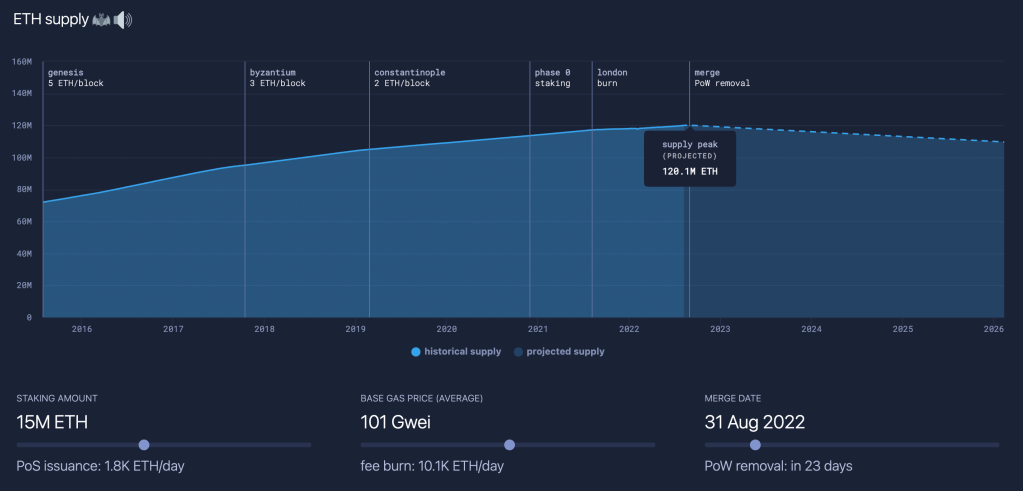
The Merge, provided it succeeds, will lead to a ~90% reduction in ETH issuance. Money supply growth will reduce from ~4% per year to close to zero. The effects of the Merge on ETH money supply can be simulated here. The overall supply of ETH in circulation will peak around the Merge and is predicted to decline going forward as the amount of ETH being burnt outstrips the amount of ETH being issued.

The Merge has been likened to a “Triple halving”, in Bitcoin parlance, because the deflationary impact of the change to PoS is roughly equivalent to the effect of three Bitcoin halvings (which of course only happens once every fourth year, with the next one on track in 2024).

With annual ETH issuance being reduced by approx. 5 million ETH, that translates to approx. $8,5b at current prices (~1.700USD/ETH). Considering that most new ETH issuance have tended to be sold directly in the market by miners, that is a lot of selling pressure that will disappear going forward after the Merge.

~99.95% less energy use

Post-Merge, Ethereum will also use ~99.95% less energy than it currently does.

Whether changing to PoS represents an improvement from PoW is a separate debate. But the change to PoS pre-empts any criticism of Ethereum for heavy energy use. If that will lead to increased adoption/investment from actors that previously have had ESG concerns remains to be seen, but it is definitely a possibility given how sticky (fair or unfair) the energy critique has been.

Miner Revolt?

So will the Merge now actually happen? Or will it be delayed yet again?

In his latest essay where he outlines why he is “max bidding” ETH Arthur Hayes makes a logical deduction why he believes the Merge now is for real. Because the one group that is both the best informed and that stand to lose the most from the Merge, namely the Ethereum miners, is turning increasingly vocal about and mobilising against the Merge.

Just like Bitcoin miners Ethereum miners have been generating revenue by solving computationally difficult puzzles to produce blocks of transactions. With the transition to PoS the miners will be rendered out of business. There are few if any other blockchains with the size and scale of Ethereum that the miners can allocate their resources to instead. Naturally they are not happy. Some have indicated that they will turn to supporting Ethereum Classic, that hard-forked from Ethereum in 2016.

Another very possible scenario is that the Merge will lead to another hard-fork and the creation of a PoW Ethereum blockchain that will continue to run in parallel with the main PoS chain.

On the other hand Ethereum founder Vitalik Buterin has played down the impact of any post-Merge hard forks.

Yield fest

Whereas the miners stand to lose, validators stand to generate attractive returns from staking ETH under the new PoS mechanism. If the Merge happened today, validators could expect to earn a total of ~8–12% APR, although yields are likely to be brought down as the demand for staking ETH increases.

The yield-earning potential from ETH staking (without the type of crazy credit risk that recently got many speculators in various DeFi yield farming schemes severly burnt) is a potential game changer, as it significantly increases the attractiveness of Ethereum as a financial asset.

Price volatility will in all likelihood continue to be a feature, but for investors that in any case would be holding ETH, the ability to pocket yields is a big added advantage.

While Ethereum remains down approximately 2/3 from the November ATH, it has doubled from the June bottoms below $1.000, as the sentiment has tentatively improved.

There is of course still a chance that the Ethereum Merge could turn into an unmitigated disaster, which in case would freeze the whole Cryptosphere in a deep winter like the White Witch of Narnia. But for the moment it does actually look like the Merge will at long last take place and turn Ethereum into an energy efficient, environmentally friendly Blockchain, that will further distinguish it from its big brother Bitcoin.