- Richard Spencer reviewing the Sana’a, Yemen-based Tim Mackintosh-Smith’s Arabs — A 3,000-Year History of Peoples, Tribes and Empires in The Times (of London): “The word ‘politics’ derives from the Greek ‘polis’, a city, and represents a collective endeavour; siyasah, the standard Arabic translation, derives from a term for the training of camels and horses.”
- “The glum philosopher star of Danish noir” — James Marriot reviewing Clare Carlisle’s new Søren Kierkegaard biography in The Times (of London).
- The FT on Big Tech waking up to the market potential of video games and Google’s launch of its cloud gaming platform, Stadia, while Reed Hatings worries about Netflix being disrupted by Fortnite. Does the race to be the “Netflix for gaming” mean the death of the console is finally coming?
- Solvitur ambulando — always golden nuggets to be found in the FT readers’ letters.
- Tim Harford on the suicide of economist / happiness expert Alan Krueger. The Economist on Krueger’s research debunking the “myth” that increases in the minimum wage must necessarily lead to lower employment.
- Wolfgang Schäuble lunching with the FT, reflecting on the assassination attempt he barely survived as Interior Minister a few days after reunification in 1990: “there’s a bang and everything changes” — implicitly drawing a chilling parallel to the 2015 decision to open Germany’s borders; “We failed to prevent [“Wir schaffen das”] being misunderstood throughout the world as a great business opportunity for human traffickers.”
- Semi-woke(?) science commentator Anjana Ahuja (is this a trend with the FT’s external reviewers?) not fully convinced by short new book on the Four Horsemen of New Atheism, summarising the quartet’s one and only meeting at Hitchens’ Washington apartment in 2007.
- Jordan Peterson responding to Cambridge’s rescindment of Visiting Fellowship offer. Cambridge dropout Toby Young in The Spectator on the same.
- Excerpt from Matt Taibi’s new book Hate Inc. on how most MSM commentators bought and promoted the Iraqi WMD narrative and has since “piled myths atop myths” to evade any responsibility for “selling the lie”. Perhaps Taibi is a bit on the conspiratorial side, but it is certainly interesting how many of the journos who were so wrong on Iraq, from Tom Friedman and Max Boot to David Frum and Robert Kagan are still considered foreign policy Experts.
- Buttonwood on the irrelevance of book value.
Author: markusreitan
Globalism and Over-Touristification in Barcelona — the case for a steep Tourist Tax!
Tourists, street vendors and rickshaw cabs are destroying Barcelona, and it is really time for them to go home.
 Last weekend I visited Barcelona for the first time in close to a decade. While the combination of big city and beach remains irresistible (and not matched by many other places, at least not in Europe), the city is becoming seriously overcrowded by tourists and risks collapsing under the weight of its own success, (if it can be called a success).
8,9m tourists stayed in Barcelona hotels in 2018, up 7m from 1990, and that is not even counting the multitudes lodging with AirBnB — in licensed as well as unlicensed accomodation (which the city government has instituted a crackdown on). According to The Daily Telegraph 32m tourists visited the city in 2016, the discrepancy explained by the fact that 23m were day-trippers.
One can see in the news that the locals have clearly had enough, with stories of attacks on tourist buses, hotels and graffiti – such as one on the ground before the Sagrada Familia: “TOURIST GO HOME!”
On the Monday, after rebooking to an evening flight, I had a pleasant and calm promenade. But during the weekend the streets are so overcrowded one can hardly navigate the narrow paths between all the fake goods of the street vendors, without being mowed down by one of the many rickshaw cabs or electric scooters terrorising pedestrian areas.
Barcelona’s problems are caused by its popularity. But the situation has reached breaking point. The city council must surely be asking if it’s worth allowing hordes of pot-smoking hipsters, surprising numbers of Goth people and endless armies of overweight Ryanair and cruise ship tourists filling up the city’s streets and beaches like a blob of stranded walruses?
The average foreign tourist spends around €1.100 per stay in Barcelona, corresponding to approx. €185 per day according to the Spain’s statistics office INE, (NB these numbers wary wildly from different sources). Tourism is clearly an important revenue source for the city, but is all of it worth it? A significant share of the portion must go straight to the pockets of the illegal street vendors hawking fake Gucci and Louis Vuitton bags, Nike sneakers, jewellery and sunglasses. (Otherwise they wouldn’t have been there. Where most of the street vendors in Spain previously have been Senegalese, many of those in Barcelona now seem to come from countries such as India or Bangladesh). And even more of the tourists’ money must obviously go to the global monoculture McDonald’s’ and Starbucks’, Nike stores and H&Ms that have crowded out local cafeterias and lifestyle from the city centre, as in so many other charmless cities.
Barcelona could probably reduce tourist traffic drastically — perhaps by as much as half — without losing that much tourism revenue. And visiting the city would then be an altogether more pleasant experience.
The Catalan government implemented a tourist tax in 2012. But the maximum rate is only €2,25 per day. In 2015 the tax raised €23m for the city of Barcelona – a meaningful amount but less than €1 per visitor (counting in the day-trippers).
The case can easily be made for a significantly steeper tourist tax. Enjoying the cultural treasures of a city like Barcelona is not a human right, if you are not willing to pay for the privilege. One-day-visiting cruise passengers are especially parasitic and should be forced to fork out much more than the €2,25 rate they are currently paying.
How high should the tourist tax go? Based on the anecdotal evidence gathered on my recent trip it should be high. A round €100 does not necessarily sound unreasonable at first blush. Or even higher? That would be radical and to some degree undemocratic. But something must surely be done to prevent great cities like Barcelona from dying the death of over-touristified monoculture “shitholes”.
Why do we get the wrong politicians?
As the Brexit saga approaches its chaotic climax, a new book seeks to answer what is wrong in Westminster.

The fact that Westminster Palace is falling apart and infested by mice, is perhaps a descriptive analogy for British politics as a whole. In the aftermath of the parliamentary expenses scandal – which revealed use of taxpayer money for private renovation projects – MPs have been too scared to allocate the necessary money to prevent bricks from falling from the ceiling and walls of Westminster, despite the fact that the palace is on the UNESCO World Heritage List as well as the very symbol of parliamentary democracy.
In her new book Why We Get the Wrong Politicians, Spectator journalist and BBC Radio 4 hostess Isabel Hardman tries to answer precisely that question. It is a timely question. With Brexit negotiations fast approaching a dramatic climax, the Tories are led by an embattled prime minister who barely survived a confidence vote in her own party and who does not really want to leave the European Union, while Labour is led by an old Communist activist who really does want Britain out of the “neo-liberal” EU. With only days left until Britain’s exit from the union will automatically be triggered by law on the 29th of March if an alternative route cannot be agreed upon, and neither the government or the opposition seem to have any clear idea of the way forward. It is safe to say British democracy ha not been experiencing its finest hour lately.
Politicians are NOT out of touch with ordinary people
So, who are these politicians making such an unholy mess of things? David Cameron answers Hardman that he does believe people who enter politics are reasonably normal, but that they are the sort of people who are prone to become completely absorbed in the political bubble. Hardman illustrates with a story from an event for military officers that she attended where also some MPs where present. The contrast between the two classes was striking: the bulky but polite military men who seemed comfortable in their own skins, versus the arrogant, less healthy-looking politicians who wore their uncertainty on their sleeves. Still, Hardman is relatively sympathetic to the men and women who voluntarily enter politics to “make a difference” in Parliament.
Hardman does not buy into the oft-repeated argument that politicians are out of touch with ordinary people. On the contrary, since the 1960s there has been a sharp increase in the amount of time MPs spend on work in their local constituencies, including surgeries (series of one-to-one meetings) with voters seeking help for everything between heaven and earth. In fact, constituency work takes up so much of MPs’ time (and mental bandwidth) that they have almost become glorified social workers.
Rather they have become glorified social workers
Contrary to popular belief, most MPs have far greater insights into the wide range of issues common people face in their encounters with different branches of the bureaucracy than most common people themselves, Hardman writes. By way of comparison: In Churchill’s day MPs could sit a lifetime in parliament and only make occasional guest appearances in the constituency they represented. The flip side of the medal is that all the time spent on constituency work leaves parliamentarians with less time and does not necessarily make them better equipped for the work they are originally supposed to do: namely, to legislate.
Lawmakers unable to make laws
The Tory MP James Gray created controversy in 2015 when he linked constituency work to the failure of politicians to properly do their job in parliament, and thereby giving the government of the day carte blanche to ram their agenda through parliament without being subjected to sufficiently rigorous scrutiny: “The complexity of government is certainly no less today than it has ever been. Legislation has in fact vastly increased in numbers in recent years, and vastly decreased in quality. Why? Because we are failing to scrutinise it properly in Parliament. Because we don’t have enough time to do so.” This is not a party political or ideological problem. It’s much worse than that, it is a systemic problem. Both the Tories and Labour have proved that they are no longer able to write laws that end up having their intended effect – Theresa May’s Brexit-in-name-only bill just being the latest case in point. Similarly, if a Prime Minister Jeremy Corbyn should proceed with his plans to re-nationalise the railroads, there is a fair chance Parliament would fail to write laws to bring such a policy into effect. A perhaps more likely outcome would be ending up at a hodgepodge halfway station combining the worst of private and public railroads.
One horror story is the Health and Social Care Act of 2012, considered by many as the Cameron government’s biggest blunder – at least before Brexit. The aim of the law was to decentralise the National Health Service and “make the changes needed”. Neither Cameron nor then Chancellor of the Exchequer George Osborne understood what those apparently much needed changes were, because they had given full responsibility for the design of the law to the allegedly brilliant Minister of Health, Andrew Lansley. However, Lansley’s genius turned out to be more theoretical than practical. In the end, apart from £3 billions of taxpayers’ money down the drain, Lansley’s resignation and mayhem in the NHS, the law achieved nothing and least of all its purported goal of decentralising public healthcare.
Cameron the Clown
After the street riots in 2011, David Cameron promised to do “whatever it takes” to “turning around the lives” of 120,000 troubled families who cost taxpayers nine billion pounds a year and were considered to be the source of the societal problems that Cameron promised to speak “clearly, frankly and truthfully” about but which he obviously had no deeper understanding of. His “solution” was very much “whatever”; namely to throw £ 448 million out of the window and hoping something would improve, somehow. When the evaluation report for the program was leaked, it became clear, frank and truthful that the effect was near zero.
In the long line of parliamentary failures, The Cameron government’s military intervention in Libya deserves a prominent place, for not learning a single lesson and repeating all of the same errors from the Blair government’s war in Iraq eight years prior. In 2016 Cameron and Blair were duly reprimanded in reports from the Foreign Affairs Committee and the Chilcot Committee respectively. The Foreign Affairs Committee laid full responsibility on Cameron for failing to formulate a coherent Libya strategy, but also criticised Parliament for failing in its job as an effective counterbalance to the government. Parliament had failed to question Cameron’s analyses and strategies (to the extent that any analyses and strategies existed at all), just as they failed to in the lead-up to Iraq in 2003. Cameron – despite having launched himself as a future elder statesman in Parliament before Brexit sent him headlong out of politics – refused to testify to the committee. MP’s finally seemed to have learned a lesson when they voted down Cameron’s haphazard plans for military action in Syria in 2013.
Is Parliament too weak?
Hardman thinks one of the main problems in Westminster is that a culture of “yes-men” has evolved, allowing the executive to bomb Middle Eastern countries back to the stone age almost without any critical being asked in Parliament. Hardman argues that this is because the career incentives for MPs are biased towards getting a role in government, rather than doing their original job as lawmakers, giving rise to a culture where most MPs slavishly follow the party whips. Otherwise, their career prospects are limited to backbench irrelevance.
Hardman believes one solution would be to strengthen the select committees in Parliament. If becoming a select committee leader could be a career path with some of the same status and prestige as being a secretary of state or minister, the incentives would not be so heavily skewed in favour of the executive to the detriment of the legislature. Some steps in this direction have been taken, such as rewarding select committee leaders with £15.000 in extra remuneration on top of the MP base salary of 74.000 pounds. The Libya report is one example showing how important the work of the select committees can be for providing effective checks and balances and upholding the separation of power principle central to parliamentary democracy.
Hardman does not believe – with a glance at the United States – that the answer to Britain’s parliamentary tangle is a full separation of legislative and executive power, as some advocate. But as the House of Commons’ controversial Speaker, John Bercow, she is supportive of strengthening Parliament vis-à-vis the executive. Bercow made a controversial manoeuvre in this direction in January when he defied precedent and his own legal advisers by allowing Parliament to vote through an amendment to the government’s business motion – forcing Theresa May to come back with a Plan B within three days after her Brexit deal was defeated in the Commons. But would a stronger Parliament really solve matters? The Brexit saga has shown a Parliament no more fit to govern than the government. The Daily Mail has denounced Parliament as the “House of Fools”, an opinion roundly shared by the British public. In a piece in the FT last weekend political correspondent Henry Mance describes the state of British politics as one where: “the government is too weak to govern, parliament too timid and too disorganised to assume the role. It’s the stoppable force versus the moveable object. It’s that scene in The Italian Job, where the bus hangs on a precipice, rocking gently forwards or backwards.” Contrary to Bercow and Harding he concludes that: “What the UK needs most of all now is not a stronger parliament. It is a half-decent government.“
Lords or Commoners
One anachronistic group which escapes relatively unscathed from Hardman’s book is the House of Lords, the British Parliament’s unelected upper chamber consisting of an unholy mix of ancient aristocrats and bishops along with modern experts and knighted party hacks. Labour MP Wes Streeting was elected in 2015 as a strong supporter of reforming the Lords to an upper house with elected representatives, as in the Commons. But after experiencing the workings of Westminster for a couple of years he has defied his democratic convictions and acknowledged that: “The Lords are much better for scrutiny than the Commons”. Those who want to throw all the remains of the old class system on scrapheap of history (Corbyn for one) should therefore be careful what they wish for – even though archconservatives such as Jacob Rees-Mogg has been as critical of the Lords (and their handling of Brexit) as progressives like Streeting have been of the Commons.
Another point of appeal Hardman has against Westminster is that becoming an MP is expensive. Her survey of 532 candidates who ran for Parliament in 2015, shows that the candidates had to spend on average 11,118 pounds from their own pocket to fund the election campaign. Hardman believes this contributes greatly to the fact that Westminster politicians are not representative of the population as a whole but are heavily over-represented by middle-aged white men with private school and Oxbridge backgrounds, who have either grown up with old money or earned new money before embarking on a political career. Furthermore, the parties’ candidate selection process is strongly biased in favour of candidates who are already inside the Westminster bubble.
Hardman is convinced that British politics would be better served with more women in Parliament (the share of female MPs has indeed risen to 32 percent), along with more MPs from more resource-poor and diverse backgrounds – without fully or convincingly explaining why that would necessarily make things better. This half-baked progressivist conclusion also goes a bit against her own perception that the unelected Lords work better than the elected Commons.
How much of Hardman’s diagnosis of British democracy is transferable to other countries? To paraphrase Tolstoy: Well-functioning democracies are all alike; every dysfunctional democracy is dysfunctional in its own way. Reading Hardman’s book gives a solemn reminder that Westminster is the place where liberal democracy was born, but also where it has grown old and tired.
Adapted from version first published in Norwegian daily Klassekampen on January 16th.
Is Harvard Studio 54? And Can America still make Airplanes?
Peter Thiel was speaking on American Democracy and economic stagnation at Harvard the other day, building on the themes he has lambasted for years. Thiel’s perspectives are as always lucid and contrarian and worth listening to:
- The techno-optimists are wrong, the economy is in secular stagnation. The Kurzweilian “Google propaganda” of runaway progress towards Singularity is false. Progress is much slower today than 50 or 100 years ago.
- Secular stagnation is primarily a supply-side problem, not a demand-side problem (as other stagnationists such as Larry Summers believe).
- And the reason for that is CULTURAL not natural. Scientific breakthroughs are still possible, scientists are just too lazy, (Thiel thinks Western culture effectively was killed around the time of Woodstock in 1969).
- Economic stagnation is a much bigger problem than economic equality – growth of 3-4+% would solve all/most problems.
- The Big STEM lie: Outside computer science (and perhaps petroleum engineering) there are no well-paying science jobs, for PhDs physics, chemistry etc. Because not much new is happening in the world of atoms. People could just as well study the humanities, where at least there is no expectation of getting a well-paying job after graduation.
- Women are not starting companies even if there are no societal barriers preventing them from doing so, (not what the feminists want to hear).
- Society has given up on complex projects.
- Startups only focus on really easy and trivial consumer internet apps. No willingness to take real risks and solve big complex challenges.
- Has modern aircraft become to complex (as Donald Trump hinted at the 737 MAX 8), or is America simply not able to produce airplanes any more?
- Communism with 5-year plans is better than Communism without 5-year plans (but still bad).
- It is not a problem getting jobs in today’s economy, with unemployment at record lows at ~3,5%, but jobs are badly paid.
- On average Americans are fine, but Americans are not average. The average house price in America is only 250k dollars. But that is as irrelevant as knowing the river you will have to cross is on average 4 feet deep. Americans are not average types existing in cyberspace. They either live in dysfunctional high-cost mega cities, with decent-paying jobs but still struggling to survive and having to endure dysfunctional 20th century public infrastructure. Or they live in flyover country where society stopped decades ago, where housing is cheap but wages even lower.
- The US should be more decentralised, not concentrating “all” economic activity in 3-4 metropolises. The UK and France even more screwed with only one mega city each.
- Should the US do like Brazil or Burma and “drain the swamp” by moving the capital city from Washington D.C?
- Silicon Valley fast approaching breaking point. Real estate too expensive and public infrastructure bottlenecked, pushing people and companies to secondary cities. Next Google, Facebook likely to come from outside Silicon Valley.
- Universities today are as corrupt as the Catholic Church in the 16th century. Harvard is basically an exclusive Studio 54 nightclub. Popularity of the institution only upheld by severly limiting access. The value of a Harvard education is not in its intellectual content (almost all of which are freely available online, or much cheaper at non-elite schools) but in the diploma/indulgence letter promising the holder a ‘fast-track’ to heaven, while those who don’t pay up will end up in a bad place.
- Thiel considered launching a new university but concluded that all US universities established after 1900 had been failures. On the other hand old universities seem able to retain their stature, irrespective of the quality of their academic offering.
- Even though the audio is bad most of the [Harvard] audience questions sound to be coming at Thiel from very woke angles, with more concern for social justice than economic stagnation, making one wonder for how much longer Ivy League diplomas can retain their illusional value?
Facebook – et samfunnsonde
NB: En litt fyldigere og uredigert versjon av undertegnedes innlegg i Klassekampen i dag.
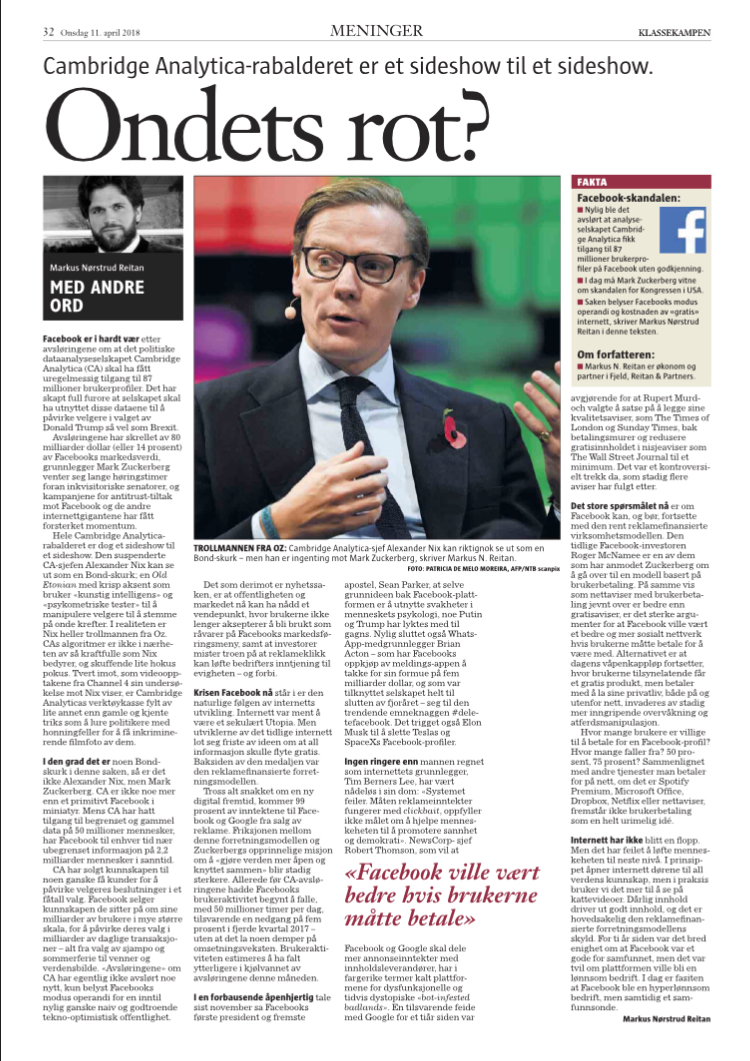
Facebooks Cambridge Analytica-skandale har blottlagt kjerneproblemet med et «gratis» internett; Mark Zuckerberg ville gjøre verden mer åpen og transparent, men endte i stedet med å skape en dystopisk digital virkelighet hvor dårlig innhold driver vekk godt.
Facebook er i hardt vær etter avsløringene om at Cambridge Analytica skal ha fått uregelmessig tilgang til 87 millioner brukerprofiler. Det har skapt full furore at det politiske dataanalyseselskapet skal ha utnyttet disse dataene til å påvirke velgere i valget av Donald Trump så vel som Brexit.
Avsløringene har skrellet av 80 milliarder dollar (eller 14 prosent) av Facebooks markedsverdi, grunnlegger Mark Zuckerberg venter seg lange høringstimer foran inkvisitoriske senatorer, og kampanjene for antitrust-tiltak mot Facebook og de andre internettgigantene har fått forsterket momentum.
Hele Cambridge Analytica-rabalderet er dog et sideshow til et sideshow. Den suspenderte Cambridge Analytica-sjefen Alexander Nix kan se ut som en Bond-skurk; en Old Etonian med nerdete briller og krisp aksent, som bruker «artifisiell intelligens» og «psykometriske» tester til å manipulere velgere til å stemme på onde krefter som Brexit og Trump som del av et globalt komplott mot «the deep state» – nesten som kopiert fra manuskriptet til Bondfilmen «Die Another Day». I realiteten er Nix trollmannen fra Oz. Cambridge Analyticas algoritmer er ikke i nærheten av så kraftfulle som Nix bedyrer til sine klienter. Det er skuffende lite hokus pokus. Tvert imot, som videoopptakene fra Channel 4’s sting-operasjon mot Nix viser, er Cambridge Analyticas verktøykasse fylt av lite mer enn gamle og kjente triks som å lure politikere med honningfeller for, ironisk nok, få inkriminerende filmfoto av dem. Lite nytt under solen der.
I den grad det er noen Bond-skurk i denne saken, så er det ikke Alexander Nix, men Mark Zuckerberg. En ung og idealistisk Skywalker som ble så blendet av egen idealisme at han i en djevelsk ironi endte opp som en mørkets fyrste. Det kan være nyttig å se det i kontekst. Cambridge Analytica er ikke noe mer enn et primitivt Facebook i miniatyr. Mens de har hatt tilgang til begrenset og gammel data på 87 millioner mennesker, har Facebook til enhver tid nær ubegrenset informasjon på 2,2 milliarder mennesker i sanntid. Cambridge Analytica har solgt denne kunnskapen til noen ganske få kunder for å påvirke velgeres beslutninger i et fåtall valg. Facebook selger kunnskapen de sitter på om sine milliarder av brukere i enormt mye større skala, for å influere deres valg i milliarder av daglige transaksjoner – alt fra valg av shampoo og sommerferie til venner og verdensbilde. Og Facebook gjør det med langt større suksess enn Cambridge Analytica, som går med stor hatt men har få kveg. «Avsløringene» om Cambridge Analytica har egentlig ikke avslørt noe nytt, men kun belyst Facebooks modus operandi for en inntil nylig ganske naiv og godtroende tekno-optimistisk offentlighet.
Det som derimot er nyhetssaken, er at offentligheten og markedet nå kan ha nådd et tipping point, hvor brukerne ikke lenger aksepterer å bli brukt som råvarer på Facebooks markedsføringsmeny, samt at investorer mister troen på at reklameklikk kan løfte bedrifters inntjening til evigheten og forbi.
Krisen Facebook nå står i er den naturlige følgen av internetts utvikling. Facebook har hatt en 14 år lang himmelferd, men har nå fløyet for nære solen. Det var kun et spørsmål om tid. Internett var ment å være et sekulært Utopia. Men slik Eva lot seg friste av slangens eple i Edens hage, lot utviklerne av det tidlige internett seg friste av ideen om at all informasjon skulle flyte gratis. Baksiden av den medaljen var den reklamefinansierte forretningsmodellen som ble internetts arvesynd.
Tross alt snakket om en ny digital fremtid og så videre, kommer 99 prosent av inntektene til Facebook og Google fra salg av reklame. Friksjonen mellom denne forretningsmodellen og Zuckerbergs opprinnelige misjon om å «make the world more open and connected», (i fjor endret til «bring the world closer together»), blir stadig sterkere. Allerede før Cambridge Analytica-avsløringene fra Facebooks brukeraktivitet (user engagement) begynt å falle, med 50 millioner timer per dag, tilsvarende en nedgang på fem prosent i fjerde kvartal 2017 – (uten at det la noen demper på omsetningsveksten). Brukeraktiviteten estimeres å ha falt ytterligere i kjølvannet av avsløringene denne måneden. Dette kan man enkelt kjenne seg igjen i. Denne skribentens personlige brukeropplevelse er at nyhetsfeeden på Facebook i økende grad blir fylt av spam. Mindre og mindre av venners feriebilder eller lenker til interessante artikler, mer og mer hjernedøde «tagg en venn som…»-poster, fake news og «inspirasjonelle» clickbait-videoer. Det er også mitt (udokumenterte) inntrykk at også kvaliteten på Googles søkemotor har tatt et steg mot det verre, med flere topptreff for søkeoptimalisert spam enn relevant kvalitetsinnhold. I en forbausende åpenhjertig tale sist november sa Facebooks første president og fremste apostel, Sean Parker at selve grunnideen bak Facebook-plattformen er å utnytte svakheter i menneskets psykologi, noe Putin og Trump har lyktes med til gangs. Parker er Facebooks Peter til Zuckerbergs Jesus, er dog ikke den eneste innsideren som har fått kalde føtter av monsteret de har skapt. Nylig sluttet også Whatsapp-medgrunnlegger Brian Acton – som har Facebooks oppkjøp av meldings-appen å takke for sin formue på fem milliarder dollar, og som var tilknyttet selskapet helt frem til slutten av fjoråret – seg til den trendende emneknaggen #deletefacebook, hvilket også trigget Elon Musk til å slette Teslas og SpaceXs Facebook-profiler.
Ingen ringere enn mannen regnet som internetts grunnlegger, Tim Berners Lee, har vært nådeløst i sin dom: «The system is failing. The way ad revenue works with clickbait is not fulfilling the goal of helping humanity promote truth and democracy». NewsCorp- sjef Robert Thomson, som vil at Facebook og Google skal dele mer annonseinntekter med innholdsleverandører, har i farverike termer kalt plattformene for dysfunksjonelle og tidvis dystopiske «bot-infested badlands». En tilsvarende feide med Google for et tiår siden var avgjørende for at Rupert Murdoch heller valgte å satse på å legge sine kvalitetsaviser, som The Times of London/Sunday Times bak betalingsmurer og redusere gratisinnholdet i nisjeaviser som The Wall Street Journal til et minimum – et kontroversielt trekk på den tiden, som stadig flere aviser har fulgt etter.
Det store spørsmålet nå er om Facebook kan, og bør, fortsette med den rent reklamefinansierte virksomhetsmodellen. Den tidlige Facebook-investoren Roger McNamee er en av dem som har anmodet Zuckerberg om å gå over til en modell basert på brukerbetaling. På samme vis som at nettaviser med brukerbetaling jevnt over er bedre enn gratisaviser, er det sterke argumenter for at Facebook ville vært et bedre og mer sosialt nettverk hvis brukerne måtte betale for å være med. Alternativet er at dagens våpenkappløp fortsetter, hvor brukerne tilsynelatende får et gratis produkt, men betaler med å la sine privatliv, både på og utenfor nett, invaderes med stadig mer inngripende overvåkning og adferdsmanipulasjon. Selv om mange av oss innbiller oss at vi ikke lar oss påvirke av Facebook- og Google-annonser, blir vi etter alt å dømme manipulert på måter vi ikke engang merker.
Hvor mye skulle Facebook-abonnement kostet? I fjor omsatte selskapet for over 40 milliarder dollar og hadde i gjennomsnitt i løpet av året omkring to milliarder brukere. Det tilsvarer 20 dollar i inntekt per bruker, ikke et veldig høyt tall. La oss for enkelhet si at Facebook avskaffet all reklame – et helt utenkelig scenario – og dyttet inntektsbortfallet over på brukerne. Hvor mange brukere er villige til å betale for en Facebook-profil? Hvor mange faller fra? 50 prosent, 75 prosent? For å opprettholde samme inntektsgrunnlag må Facebook da kreve brukerne for 40 – 80 dollar i året, tilsvarende 3 – 7 dollar i måneden. Sammenlignet med andre ting man betaler for på nett, om det er Spotify Premium ($7), Microsoft Office ($8,25), Google bedriftsmail ($10-25), Dropbox ($10), Netflix ($8-12) eller nettaviser, fremstår ikke det som urimelig høyt.
Internett har ikke blitt en flopp. Men det har feilet å løfte menneskeheten til neste nivå. I prinsippet åpner internett dørene til all verdens kunnskap, men i praksis bruker vi det mer til å se på kattevideoer. En omskrivning av Greshams lov for internett dikterer at dårlig innhold driver ut godt innhold. Det er hovedsakelig den dominerende reklamefinansierte forretningsmodellens skyld. For ti år siden var det bred enighet om at Facebook var et gode for samfunnet, men det var tvil om plattformen ville bli en lønnsom bedrift. I dag er fasit at Facebook ble en hyperlønnsom bedrift, men samtidig et samfunnsonde.
Sjakk, Politikk & Ekspertise
Fra Klassekampen 31. august

I litt mer lesbart format:
Bjørn Vassnes skriver interessant om Anders Ericsson og Robert Pools bok om ekspertise i Klassekampen Viten (Myten om medfødt talent & Uten strategi blir det bare rot, torsdag 3. august)
Vassnes drøfter blant annet spørsmålet om hvorfor Benjamin Franklin, som både var en briljant vitenskapsmann og politiker, kun forble en middelmådig sjakkspiller – tross at han tilbragte utallige timer ved brettet. Jeg har ingen innvendinger mot Vassnes’ forklaringer på Franklins uteblivende progresjon, nemlig mangelen på mentorer, mangel på sjakkteoretisk litteratur og fraværet av noen overordnet strategi og mål – i kontrast til den tydelig definerte strategien og målene Franklin hadde i sin skrivevirksomhet. Men vi kan kanskje få ytterligere innsikt ved å legge til en ekstra dimensjon: spill versus virkelighet.
Den rake motsetningen til Benjamin Franklin finner man i Garry Kasparov. Mens Franklin var en genial politiker, men dårlig sjakkspiller, var Kasparov en genial sjakkspiller men er en elendig politiker. Hvorfor?
I sin kjente bok fra 2007, The Black Swan, introduserte den libanesisk-amerikanske forfatteren Nassim Nicholas Taleb konseptet Ludic Fallacy: misbruk av spill for å modellere virkelige situasjoner. Spill opererer med definerte rammer som gjør at mennesker kan læres og maskiner programmeres for å oppnå optimal prestasjon, innenfor gitte rammeverk. Men når tar med operative forutsetninger fra en idealisert spillverden til en mer kompleks virkelighet, går det ofte ad undas. Ingen illustrerer dette bedre enn Kasparov. Da han meldte sin inntreden i russisk politikk, anså flere ham (ikke urimelig) som en mulig seriøs utfordrer til Vladimir Putin. Slik gikk det ikke
På et sjakkbrett med 64 ruter, 16 hvite og 16 sorte brikker som kan flyttes etter bestemte regler, var Kasparov nær uslåelig. I russisk politikk er Kasparov en ensom bonde. Marginalisert og maktesløs. Putins evig skiftende sjakkbrett har ingen definerte grenser, avgrensede ruter eller konsekvente regler. Ruter kan fjernes og legges til. Det er ingen sorthvite kontraster, alt er bare grumsete grått. En bonde i går, kan være en biskop i dag, og en bonde igjen i morgen. Kun kongen vet hvilke brikker som kan flyttes hvor og når, hvilke som ikke kan flyttes i det hele tatt, og hvilke som forsvinner.
Russisk politikk er med andre ord et vanskeligere spill enn sjakk. I dette spillet har ikke Kasparovs sjakkunnskaper hjulpet ham stort – de kan til og med ha stått i veien for ham. Andre eksempel kan være proffbokseren som taper et barslagsmål mot en mafioso som slår under beltestedet, eller Nobelprisvinnerne i økonomisk teori som tok med sine matematiske modeller ut i det virkelige markedet og sørget for en av tidenes største finansielle kollapser med hedgefondet Long Term Capital Management – ironisk nok dels fordi prisene på russiske statsobligasjoner ikke beveget seg så rasjonelt som tekstboken tilsa. Både LTCM og Kasparovs strategier fra spill- og teoriverden brøt sammen i møte med virkeligheten. Franklin og Putin hadde/har derimot tydelige overordnede mål, (amerikansk uavhengighet og å gjenreise Russland som stormakt), men fleksible i anvendelse av strategi for å nå målene. Kritikere hevder Putin ikke har noen strategi, men bare agerer ad-hoc. Det er trolig grunnen til at han har klart å beholde makten i 17 år. Når virkeligheten forandrer seg, endrer Putin seg, (vektleggelse av økonomisk vekst 2000-08, av nasjonalisme fra 2012 til i dag). Når Kasparovs modell (liberalt demokrati i Russland) ikke stemmer med virkeligheten (Putinisme), sier Kasparov at virkeligheten er feil, og kjører videre med samme ufruktbare strategi. Tittelen på Kasparovs forrige bok “How life imitates chess”, eksemplifiserer hvordan han i tråd med the Ludic Fallacy, ser livet som et sjakkbrett, mens sjakkbrettet i realiteten bare er en liten del av livet.
Så kanskje man kan finne svaret på hvorfor lynsmarte Franklin aldri ble mer enn en middelmådig sjakkspiller, i hvorfor lynsmarte Kasparov aldri ble mer enn en ubrukelig politiker. Noen disipliner er det kanskje lettere å trene seg til ekspertise i, som sjakk, enn andre, som russisk politikk.
Ericssons teori om at det bare handler om trening og ikke talent, er likevel for normativ og svensk-idealistisk til å tro. Er Michael Phelps verdens beste svømmer simpelthen fordi han trener mer enn de andre? Eller har det også å gjøre med at kroppen hans er halvt menneske, halvt fisk – med skostørrelse 48,5, 203cm mellom fingertuppene, ekstra tøyelige ledd og lungekapasiteten til to vanlige mennesker? Eller hva med golfspilleren Greg Norman, som var verdens beste i over seks år. Norman tok ikke opp en golfkølle før han var 15 år, men han hadde en mor som var en habil golfspiller. Kan medfødt talent hatt en finger med i spillet?
Det er mulig Ericsson og Pools bok gir foreldre nyttige tips for å avle opp en Kasparov eller en Federer, (gitt at de fysiske forutsetningen som forfatterne virker å bevisst ignorere, er tilstede). 10.000 timer med «deliberate practice». Enkelt og greit. Men for foreldre som vil fostre opp en «Putin» rustet for den komplekse verden utenfor sjakkbrettet og tennisbanen, tror jeg Ericsson og Pools råd er lite verdt. Hva slags trening skulle man fylt opp de 10.000 timene med da?
The Googlememo
Interesting story on the explosive “anti-diversity” memo circulating inside Google:
“The person who wrote the document argued that the representation gap between men and women in software engineering persists because of biological differences between the two sexes, according to public tweets from Google employees. It also said Google should not offer programs for underrepresented racial or gender minorities”
And link to the full #googlememo :
“Philosophically, I don’t think we should do arbitrary social engineering of tech just to make it appealing to equal portions of both men and women. For each of these changes, we need principles reasons for why it helps Google; that is, we should be optimizing for Google—with Google’s diversity being a component of that. For example currently those trying to work extra hours or take extra stress will inevitably get ahead and if we try to change that too much, it may have disastrous consequences. Also, when considering the costs and benefits, we should keep in mind that Google’s funding is finite so its allocation is more zero-sum than is generally acknowledged.”
Will be interesting to see where this story goes from here.
The myth of the Weightless Economy

An interesting interview with Bill Gates’ “favourite thinker”, Vaclav Smil on his book “Making the Modern World: Materials and Dematerialization.”
Smil is particularly scathing in his assessment of Silicon Valley’s contribution to “making the world a better place”:
“I wouldn’t put a big trust in what people in Silicon Valley say,” he says. “They may be good at manipulating ones and zeroes and writing software, but beyond that their contribution to human progress has been pretty dismal.”
When Bill Gates have had disagreements in the past with Mark Zuckerberg over the importance of poor countries’ access to internet vs basic human needs such as access to water or vaccines, his thinking is likely to have been influenced by Smil.
And nobody has done more to debunk the myth of the “Weightless Economy” – the theory that digitalization would lead to dematerialization – than Smil. While technology has enabled some relative dematerialization, this has not translated to any absolute declines in materialization on the global scale – as huge numbers of people in emerging economies have joined the global middle class and adopted more resource-intensive lifetyles.
As illustrated by the tripling of global paper even though we were supposed to be having paperless offices by now, (I am writing this post as a break from the tedious process of printing and scanning 80-odd pages):
“Some years ago, everyone was enthusiastic about the paperless office that would be made possible by the advent of word processing and computers. Well, it didn’t happen. The consumption of paper has tripled in the last 20 years.”
Another reason that dematerialization has failed to happen is because we simply produce so much bad stuff, and turn it over much more rapidly than before. A new iPhone may be lighter than a 1990’s-era Ericsson or Nokia, but it has a much shorter lifespan. Equally with cars, and probably houses too. Smil makes a simple but strong argument for producing more durable stuff:
The other obvious solution, Smil points out, “is to build the quality of longevity into products. There is no reason we can’t design a car to last for 35 years instead of six or seven. This is the core of the matter.”
While Smil is mostly focused on the macro level, his insights have implications on the company level too. In the textbook version of the weightless economy profit margins for technology firms with “scalable” business models should have been almost ever-increasing. But it has largely failed to happen. Even digital firms like Google and Facebook (with very high profit margins) are not nearly as dematerialized in practice as theory would have it, (which I intend to come back to in another post).
So what is to be done?
Well, Smil has no interest in playing God, and neither does he hold much belief in the many Messiahs popping up in Silicon Valley on an almost daily basis:
“I don’t propose,” he says. “I’m old fashioned. I’m not one of these young guys who think they are so smart that they can prescribe what humanity ought to do. Humanity never learns any lessons. Prescriptions don’t matter. We already know exactly what to do. We just don’t do it.”
Good Reads
- First Golfer Donald Trump. Have been waiting for a long-form article on Trump the golfer, as it often is on the golf course one’s true character is revealed – warts and all. Alan Shipnuck’s article in SI is probably one of the better ones written on Trump – especially if you are a golfer.
- Ricardo Hausman on the unprecedented depth of Venezuela’s economic collapse.
- The slow death of the A380 signalling the end of an aviation dream (and the end of progress in general?) by Michael Skapinker in the FT.
- An extract from Seth Stephens-Davidowitz’s very interesting new book on how big data are now revealing our darkest secrets and lies.
- Bannon as the heir to Plato(?)
- Why true experts break the rules.
Norwegian traffic deaths approaching zero
New numbers from Statens Vegvesen (The Norwegian Public Roads Administration) show that road traffic deaths in Norway almost halved in June and July compared to the same period last year.
Which begs the question: Are traffic accidents in Norway about to be eradicated as a cause of death?
The preliminary numbers show that traffic deaths fell by 46 percent to 20 from 37 last summer (which was the highest number in the last five years):
| 2017 | 2016 | 2015 | 2014 | 2013 | |
| June | 12 | 15 | 9 | 18 | 16 |
| July | 8* | 22 | 15 | 18 | 17 |
| Total | 20* | 37 | 24 | 36 | 33 |
So far this year 57 lives have been lost in road traffic accidents, down from 84 in the first seven months of 2016.
If this trend continues 2017 may be the first year with less than 100 traffic deaths since 1947. According to the NPRA Norway has been ranked Europe’s best country for traffic safety with the lowest number of fatalities and the lowest risk of accidents for the second year running – (though they don’t specify by which agency).
(According to these numbers from the WHO several countries had lower road fatalities per 100.000 inhabitants per year than Norway (3,8) back in 2013, including Sweden (2,8), the UK (2,9), Denmark (3,5) and Spain (3,7).
While the NPRA report does not enquire into the causes of the decline in traffic fatalities, both the significant increase in infrastrucure spending started during the Stoltenberg government as well as strict enforcement of speed limits, including the proliferation of average speed controls over longer distances, may have explanatory power. The debate whether lower death numbers should mainly be attributed to better roads (with higher speed limits) or lower speeds are unlikely to be resolved anytime soon.
In any event, Norway is no at a point where the semi-Utopian vision of zero traffic deaths are within reach, (in theory at least), which certainly is feat worth celebrating.
However, there are trade-offs. What is the ideal number of traffic deaths in a society? 0? From a (coldly) utilitarian perspective the optimum number of traffic deaths in order to maximize societal (not individual) utility is probably above zero.
My anecdotal evidence suggests that average speed controls in Norway (over ~5-10km stretches) lead to significantly below limit speeds – with driving speeds below 60 km/h in 80 km/h zones for instance. Adding up for all drivers/passengers in the course of a year, that translates to substantial amounts of superfluous time spent/wasted in traffic.
The cost in terms of loss of economic activity is probably not insignificant. On a deeper more philosophical note it may be asked what a population driving along in 60 in 80 zones does to the long-term vitality of a nation?
 Western Decline