Facebook – et samfunnsonde

NB: En litt fyldigere og uredigert versjon av undertegnedes innlegg i Klassekampen i dag.
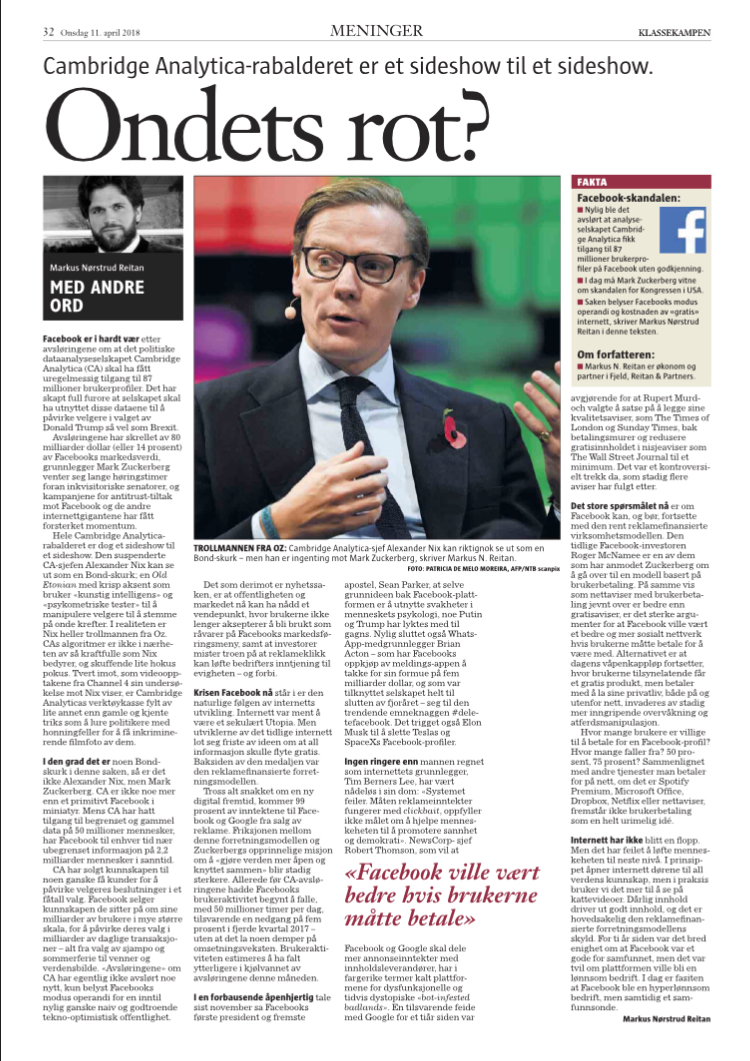
Facebook en samfunnsfiende

Facebooks Cambridge Analytica-skandale har blottlagt kjerneproblemet med et «gratis» internett; Mark Zuckerberg ville gjøre verden mer åpen og transparent, men endte i stedet med å skape en dystopisk digital virkelighet hvor dårlig innhold driver vekk godt.

Facebook er i hardt vær etter avsløringene om at Cambridge Analytica skal ha fått uregelmessig tilgang til 87 millioner brukerprofiler. Det har skapt full furore at det politiske dataanalyseselskapet skal ha utnyttet disse dataene til å påvirke velgere i valget av Donald Trump så vel som Brexit.

Avsløringene har skrellet av 80 milliarder dollar (eller 14 prosent) av Facebooks markedsverdi, grunnlegger Mark Zuckerberg venter seg lange høringstimer foran inkvisitoriske senatorer, og kampanjene for antitrust-tiltak mot Facebook og de andre internettgigantene har fått forsterket momentum.

Hele Cambridge Analytica-rabalderet er dog et sideshow til et sideshow. Den suspenderte Cambridge Analytica-sjefen Alexander Nix kan se ut som en Bond-skurk; en Old Etonian med nerdete briller og krisp aksent, som bruker «artifisiell intelligens» og «psykometriske» tester til å manipulere velgere til å stemme på onde krefter som Brexit og Trump som del av et globalt komplott mot «the deep state» – nesten som kopiert fra manuskriptet til Bondfilmen «Die Another Day». I realiteten er Nix trollmannen fra Oz. Cambridge Analyticas algoritmer er ikke i nærheten av så kraftfulle som Nix bedyrer til sine klienter. Det er skuffende lite hokus pokus. Tvert imot, som videoopptakene fra Channel 4’s sting-operasjon mot Nix viser, er Cambridge Analyticas verktøykasse fylt av lite mer enn gamle og kjente triks som å lure politikere med honningfeller for, ironisk nok, få inkriminerende filmfoto av dem. Lite nytt under solen der.

I den grad det er noen Bond-skurk i denne saken, så er det ikke Alexander Nix, men Mark Zuckerberg. En ung og idealistisk Skywalker som ble så blendet av egen idealisme at han i en djevelsk ironi endte opp som en mørkets fyrste. Det kan være nyttig å se det i kontekst. Cambridge Analytica er ikke noe mer enn et primitivt Facebook i miniatyr. Mens de har hatt tilgang til begrenset og gammel data på 87 millioner mennesker, har Facebook til enhver tid nær ubegrenset informasjon på 2,2 milliarder mennesker i sanntid. Cambridge Analytica har solgt denne kunnskapen til noen ganske få kunder for å påvirke velgeres beslutninger i et fåtall valg. Facebook selger kunnskapen de sitter på om sine milliarder av brukere i enormt mye større skala, for å influere deres valg i milliarder av daglige transaksjoner – alt fra valg av shampoo og sommerferie til venner og verdensbilde. Og Facebook gjør det med langt større suksess enn Cambridge Analytica, som går med stor hatt men har få kveg. «Avsløringene» om Cambridge Analytica har egentlig ikke avslørt noe nytt, men kun belyst Facebooks modus operandi for en inntil nylig ganske naiv og godtroende tekno-optimistisk offentlighet.

Det som derimot er nyhetssaken, er at offentligheten og markedet nå kan ha nådd et tipping point, hvor brukerne ikke lenger aksepterer å bli brukt som råvarer på Facebooks markedsføringsmeny, samt at investorer mister troen på at reklameklikk kan løfte bedrifters inntjening til evigheten og forbi.

Krisen Facebook nå står i er den naturlige følgen av internetts utvikling. Facebook har hatt en 14 år lang himmelferd, men har nå fløyet for nære solen. Det var kun et spørsmål om tid. Internett var ment å være et sekulært Utopia. Men slik Eva lot seg friste av slangens eple i Edens hage, lot utviklerne av det tidlige internett seg friste av ideen om at all informasjon skulle flyte gratis. Baksiden av den medaljen var den reklamefinansierte forretningsmodellen som ble internetts arvesynd.

Tross alt snakket om en ny digital fremtid og så videre, kommer 99 prosent av inntektene til Facebook og Google fra salg av reklame. Friksjonen mellom denne forretningsmodellen og Zuckerbergs opprinnelige misjon om å «make the world more open and connected», (i fjor endret til «bring the world closer together»), blir stadig sterkere. Allerede før Cambridge Analytica-avsløringene fra Facebooks brukeraktivitet (user engagement) begynt å falle, med 50 millioner timer per dag, tilsvarende en nedgang på fem prosent i fjerde kvartal 2017 – (uten at det la noen demper på omsetningsveksten). Brukeraktiviteten estimeres å ha falt ytterligere i kjølvannet av avsløringene denne måneden. Dette kan man enkelt kjenne seg igjen i. Denne skribentens personlige brukeropplevelse er at nyhetsfeeden på Facebook i økende grad blir fylt av spam. Mindre og mindre av venners feriebilder eller lenker til interessante artikler, mer og mer hjernedøde «tagg en venn som…»-poster, fake news og «inspirasjonelle» clickbait-videoer. Det er også mitt (udokumenterte) inntrykk at også kvaliteten på Googles søkemotor har tatt et steg mot det verre, med flere topptreff for søkeoptimalisert spam enn relevant kvalitetsinnhold. I en forbausende åpenhjertig tale sist november sa Facebooks første president og fremste apostel, Sean Parker at selve grunnideen bak Facebook-plattformen er å utnytte svakheter i menneskets psykologi, noe Putin og Trump har lyktes med til gangs. Parker er Facebooks Peter til Zuckerbergs Jesus, er dog ikke den eneste innsideren som har fått kalde føtter av monsteret de har skapt. Nylig sluttet også Whatsapp-medgrunnlegger Brian Acton – som har Facebooks oppkjøp av meldings-appen å takke for sin formue på fem milliarder dollar, og som var tilknyttet selskapet helt frem til slutten av fjoråret – seg til den trendende emneknaggen #deletefacebook, hvilket også trigget Elon Musk til å slette Teslas og SpaceXs Facebook-profiler.

Ingen ringere enn mannen regnet som internetts grunnlegger, Tim Berners Lee, har vært nådeløst i sin dom: «The system is failing. The way ad revenue works with clickbait is not fulfilling the goal of helping humanity promote truth and democracy». NewsCorp- sjef Robert Thomson, som vil at Facebook og Google skal dele mer annonseinntekter med innholdsleverandører, har i farverike termer kalt plattformene for dysfunksjonelle og tidvis dystopiske «bot-infested badlands». En tilsvarende feide med Google for et tiår siden var avgjørende for at Rupert Murdoch heller valgte å satse på å legge sine kvalitetsaviser, som The Times of London/Sunday Times bak betalingsmurer og redusere gratisinnholdet i nisjeaviser som The Wall Street Journal til et minimum – et kontroversielt trekk på den tiden, som stadig flere aviser har fulgt etter.

Det store spørsmålet nå er om Facebook kan, og bør, fortsette med den rent reklamefinansierte virksomhetsmodellen. Den tidlige Facebook-investoren Roger McNamee er en av dem som har anmodet Zuckerberg om å gå over til en modell basert på brukerbetaling. På samme vis som at nettaviser med brukerbetaling jevnt over er bedre enn gratisaviser, er det sterke argumenter for at Facebook ville vært et bedre og mer sosialt nettverk hvis brukerne måtte betale for å være med. Alternativet er at dagens våpenkappløp fortsetter, hvor brukerne tilsynelatende får et gratis produkt, men betaler med å la sine privatliv, både på og utenfor nett, invaderes med stadig mer inngripende overvåkning og adferdsmanipulasjon. Selv om mange av oss innbiller oss at vi ikke lar oss påvirke av Facebook- og Google-annonser, blir vi etter alt å dømme manipulert på måter vi ikke engang merker.

Hvor mye skulle Facebook-abonnement kostet? I fjor omsatte selskapet for over 40 milliarder dollar og hadde i gjennomsnitt i løpet av året omkring to milliarder brukere. Det tilsvarer 20 dollar i inntekt per bruker, ikke et veldig høyt tall. La oss for enkelhet si at Facebook avskaffet all reklame – et helt utenkelig scenario – og dyttet inntektsbortfallet over på brukerne. Hvor mange brukere er villige til å betale for en Facebook-profil? Hvor mange faller fra? 50 prosent, 75 prosent? For å opprettholde samme inntektsgrunnlag må Facebook da kreve brukerne for 40 – 80 dollar i året, tilsvarende 3 – 7 dollar i måneden. Sammenlignet med andre ting man betaler for på nett, om det er Spotify Premium ($7), Microsoft Office ($8,25), Google bedriftsmail ($10-25), Dropbox ($10), Netflix ($8-12) eller nettaviser, fremstår ikke det som urimelig høyt.

Internett har ikke blitt en flopp. Men det har feilet å løfte menneskeheten til neste nivå. I prinsippet åpner internett dørene til all verdens kunnskap, men i praksis bruker vi det mer til å se på kattevideoer. En omskrivning av Greshams lov for internett dikterer at dårlig innhold driver ut godt innhold. Det er hovedsakelig den dominerende reklamefinansierte forretningsmodellens skyld. For ti år siden var det bred enighet om at Facebook var et gode for samfunnet, men det var tvil om plattformen ville bli en lønnsom bedrift. I dag er fasit at Facebook ble en hyperlønnsom bedrift, men samtidig et samfunnsonde.


Sjakk, Politikk & Ekspertise

Fra Klassekampen 31. august

IMG_1515

I litt mer lesbart format:

Bjørn Vassnes skriver interessant om Anders Ericsson og Robert Pools bok om ekspertise i Klassekampen Viten (Myten om medfødt talent & Uten strategi blir det bare rot, torsdag 3. august)

Vassnes drøfter blant annet spørsmålet om hvorfor Benjamin Franklin, som både var en briljant vitenskapsmann og politiker, kun forble en middelmådig sjakkspiller – tross at han tilbragte utallige timer ved brettet. Jeg har ingen innvendinger mot Vassnes’ forklaringer på Franklins uteblivende progresjon, nemlig mangelen på mentorer, mangel på sjakkteoretisk litteratur og fraværet av noen overordnet strategi og mål – i kontrast til den tydelig definerte strategien og målene Franklin hadde i sin skrivevirksomhet. Men vi kan kanskje få ytterligere innsikt ved å legge til en ekstra dimensjon: spill versus virkelighet.

Den rake motsetningen til Benjamin Franklin finner man i Garry Kasparov. Mens Franklin var en genial politiker, men dårlig sjakkspiller, var Kasparov en genial sjakkspiller men er en elendig politiker. Hvorfor?

I sin kjente bok fra 2007, The Black Swan, introduserte den libanesisk-amerikanske forfatteren Nassim Nicholas Taleb konseptet Ludic Fallacy: misbruk av spill for å modellere virkelige situasjoner. Spill opererer med definerte rammer som gjør at mennesker kan læres og maskiner programmeres for å oppnå optimal prestasjon, innenfor gitte rammeverk. Men når tar med operative forutsetninger fra en idealisert spillverden til en mer kompleks virkelighet, går det ofte ad undas. Ingen illustrerer dette bedre enn Kasparov. Da han meldte sin inntreden i russisk politikk, anså flere ham (ikke urimelig) som en mulig seriøs utfordrer til Vladimir Putin. Slik gikk det ikke

På et sjakkbrett med 64 ruter, 16 hvite og 16 sorte brikker som kan flyttes etter bestemte regler, var Kasparov nær uslåelig. I russisk politikk er Kasparov en ensom bonde. Marginalisert og maktesløs. Putins evig skiftende sjakkbrett har ingen definerte grenser, avgrensede ruter eller konsekvente regler. Ruter kan fjernes og legges til. Det er ingen sorthvite kontraster, alt er bare grumsete grått.  En bonde i går, kan være en biskop i dag, og en bonde igjen i morgen. Kun kongen vet hvilke brikker som kan flyttes hvor og når, hvilke som ikke kan flyttes i det hele tatt, og hvilke som forsvinner.

Russisk politikk er med andre ord et vanskeligere spill enn sjakk. I dette spillet har ikke Kasparovs sjakkunnskaper hjulpet ham stort – de kan til og med ha stått i veien for ham. Andre eksempel kan være proffbokseren som taper et barslagsmål mot en mafioso som slår under beltestedet, eller Nobelprisvinnerne i økonomisk teori som tok med sine matematiske modeller ut i det virkelige markedet og sørget for en av tidenes største finansielle kollapser med hedgefondet Long Term Capital Management – ironisk nok dels fordi prisene på russiske statsobligasjoner ikke beveget seg så rasjonelt som tekstboken tilsa. Både LTCM og Kasparovs strategier fra spill- og teoriverden brøt sammen i møte med virkeligheten. Franklin og Putin hadde/har derimot tydelige overordnede mål, (amerikansk uavhengighet og å gjenreise Russland som stormakt), men fleksible i anvendelse av strategi for å nå målene. Kritikere hevder Putin ikke har noen strategi, men bare agerer ad-hoc. Det er trolig grunnen til at han har klart å beholde makten i 17 år. Når virkeligheten forandrer seg, endrer Putin seg, (vektleggelse av økonomisk vekst 2000-08, av nasjonalisme fra 2012 til i dag). Når Kasparovs modell (liberalt demokrati i Russland) ikke stemmer med virkeligheten (Putinisme), sier Kasparov at virkeligheten er feil, og kjører videre med samme ufruktbare strategi. Tittelen på Kasparovs forrige bok “How life imitates chess”, eksemplifiserer hvordan han i tråd med the Ludic Fallacy, ser livet som et sjakkbrett, mens sjakkbrettet i realiteten bare er en liten del av livet.

Så kanskje man kan finne svaret på hvorfor lynsmarte Franklin aldri ble mer enn en middelmådig sjakkspiller, i hvorfor lynsmarte Kasparov aldri ble mer enn en ubrukelig politiker. Noen disipliner er det kanskje lettere å trene seg til ekspertise i, som sjakk, enn andre, som russisk politikk.

Ericssons teori om at det bare handler om trening og ikke talent, er likevel for normativ og svensk-idealistisk til å tro. Er Michael Phelps verdens beste svømmer simpelthen fordi han trener mer enn de andre? Eller har det også å gjøre med at kroppen hans er halvt menneske, halvt fisk – med skostørrelse 48,5, 203cm mellom fingertuppene, ekstra tøyelige ledd og lungekapasiteten til to vanlige mennesker? Eller hva med golfspilleren Greg Norman, som var verdens beste i over seks år. Norman tok ikke opp en golfkølle før han var 15 år, men han hadde en mor som var en habil golfspiller. Kan medfødt talent hatt en finger med i spillet?

Det er mulig Ericsson og Pools bok gir foreldre nyttige tips for å avle opp en Kasparov eller en Federer, (gitt at de fysiske forutsetningen som forfatterne virker å bevisst ignorere, er tilstede). 10.000 timer med «deliberate practice». Enkelt og greit. Men for foreldre som vil fostre opp en «Putin» rustet for den komplekse verden utenfor sjakkbrettet og tennisbanen, tror jeg Ericsson og Pools råd er lite verdt. Hva slags trening skulle man fylt opp de 10.000 timene med da?

The Googlememo

Interesting story on the explosive “anti-diversity” memo circulating inside Google:

“The person who wrote the document argued that the representation gap between men and women in software engineering persists because of biological differences between the two sexes, according to public tweets from Google employees. It also said Google should not offer programs for underrepresented racial or gender minorities”

And link to the full #googlememo :

“Philosophically, I don’t think we should do arbitrary social engineering of tech just to make it appealing to equal portions of both men and women. For each of these changes, we need principles reasons for why it helps Google; that is, we should be optimizing for Google—with Google’s diversity being a component of that. For example currently those trying to work extra hours or take extra stress will inevitably get ahead and if we try to change that too much, it may have disastrous consequences. Also, when considering the costs and benefits, we should keep in mind that Google’s funding is finite so its allocation is more zero-sum than is generally acknowledged.”

Will be interesting to see where this story goes from here.


The myth of the Weightless Economy

FullSizeRender (4).jpg

An interesting interview with Bill Gates’ “favourite thinker”, Vaclav Smil on his book “Making the Modern World: Materials and Dematerialization.”

Smil is particularly scathing in his assessment of Silicon Valley’s contribution to “making the world a better place”:

“I wouldn’t put a big trust in what people in Silicon Valley say,” he says. “They may be good at manipulating ones and zeroes and writing software, but beyond that their contribution to human progress has been pretty dismal.”

When Bill Gates have had disagreements in the past with Mark Zuckerberg over the importance of poor countries’ access to internet vs basic human needs such as access to water or vaccines, his thinking is likely to have been influenced by Smil.

And nobody has done more to debunk the myth of the “Weightless Economy” – the theory that digitalization would lead to dematerialization – than Smil. While technology has enabled some relative dematerialization, this has not translated to any absolute declines in materialization on the global scale – as huge numbers of people in emerging economies have joined the global middle class and adopted more resource-intensive lifetyles.

As illustrated by the tripling of global paper even though we were supposed to be having paperless offices by now, (I am writing this post as a break from the tedious process of printing and scanning 80-odd pages):

“Some years ago, everyone was enthusiastic about the paperless office that would be made possible by the advent of word processing and computers. Well, it didn’t happen. The consumption of paper has tripled in the last 20 years.”

Another reason that dematerialization has failed to happen is because we simply produce so much bad stuff, and turn it over much more rapidly than before. A new iPhone may be lighter than a 1990’s-era Ericsson or Nokia, but it has a much shorter lifespan. Equally with cars, and probably houses too. Smil makes a simple but strong argument for producing more durable stuff:

The other obvious solution, Smil points out, “is to build the quality of longevity into products. There is no reason we can’t design a car to last for 35 years instead of six or seven. This is the core of the matter.”

While Smil is mostly focused on the macro level, his insights have implications on the company level too. In the textbook version of the weightless economy profit margins for technology firms with “scalable” business models should have been almost ever-increasing. But it has largely failed to happen. Even digital firms like Google and Facebook (with very high profit margins) are not nearly as dematerialized in practice as theory would have it, (which I intend to come back to in another post).

So what is to be done?

Well, Smil has no interest in playing God, and neither does he hold much belief in the many Messiahs popping up in Silicon Valley on an almost daily basis:

“I don’t propose,” he says. “I’m old fashioned. I’m not one of these young guys who think they are so smart that they can prescribe what humanity ought to do. Humanity never learns any lessons. Prescriptions don’t matter. We already know exactly what to do. We just don’t do it.”

Good Reads

Norwegian traffic deaths approaching zero

New numbers from Statens Vegvesen (The Norwegian Public Roads Administration) show that road traffic deaths in Norway almost halved in June and July compared to the same period last year.

Which begs the question: Are traffic accidents in Norway about to be eradicated as a cause of death?

The preliminary numbers show that traffic deaths fell by 46 percent to 20 from 37 last summer (which was the highest number in the last five years):

  2017 2016 2015 2014 2013
June 12 15   9 18 16
July   8* 22 15 18 17
Total 20* 37 24 36 33

So far this year 57 lives have been lost in road traffic accidents, down from 84 in the first seven months of 2016.

If this trend continues 2017 may be the first year with less than 100 traffic deaths since 1947. According to the NPRA Norway has been ranked Europe’s best country for traffic safety with the lowest number of fatalities and the lowest risk of accidents for the second year running – (though they don’t specify by which agency).

(According to these numbers from the WHO several countries had lower road fatalities per 100.000 inhabitants per year than Norway (3,8) back in 2013, including Sweden (2,8), the UK (2,9), Denmark (3,5) and Spain (3,7).

While the NPRA report does not enquire into the causes of the decline in traffic fatalities, both the significant increase in infrastrucure spending started during the Stoltenberg government as well as strict enforcement of speed limits, including the proliferation of average speed controls over longer distances, may have explanatory power. The debate whether lower death numbers should mainly be attributed to better roads (with higher speed limits) or lower speeds are unlikely to be resolved anytime soon.

In any event, Norway is no at a point where the semi-Utopian vision of zero traffic deaths are within reach, (in theory at least), which certainly is feat worth celebrating.

However, there are trade-offs. What is the ideal number of traffic deaths in a society? 0? From a (coldly) utilitarian perspective the optimum number of traffic deaths in order to maximize societal (not individual) utility is probably above zero.

My anecdotal evidence suggests that average speed controls in Norway (over ~5-10km stretches) lead to significantly below limit speeds – with driving speeds below 60 km/h in 80 km/h zones for instance. Adding up for all drivers/passengers in the course of a year, that translates to substantial amounts of superfluous time spent/wasted in traffic.

The cost in terms of loss of economic activity is probably not insignificant. On a deeper more philosophical note it may be asked what a population driving along in 60 in 80 zones does to the long-term vitality of a nation?


The Rise of the Trump Dynasty: Can Ivanka win in 2024?

Tyler Cowen linked to Edward Luttwak’s TLS review of a quartet of books on how Hillary Clinton managed to lose the election.

However, the book essay is more interesting for Luttwak’s speculation about the rise of a Trump Dynasty, with the prospect of eight years of Donald to be followed by eight years of Ivanka.

The idea is neither new nor original But given Luttwak’s reputation as an astute historian of the grand strategy of empires, from the Roman to the Soviet, it may well be worth giving him a fair if brief hearing. The Ivanka scenario may not be as outlandish as it sounds. I for example particularly liked the Ivanka 2066winner of Gideon Rachman’s hypothetical history exam in the FT. Written before the election, Jeremy Shapiro’s essay (to the extent this very unserious text can be taken seriously at all) assumed that Ivanka would win the presidency in 2036, even after her father’s loss in 2016.

No matter how unpopular President Trump becomes, Ivanka’s chances to reach the same office is likely to be higher than if her father had never become president. Even in the post-dynastic age political capital is remarkably hereditary, perhaps even more hereditary than financial or other forms of capital. And inter-generational political capital even seems to be remarkably resistant to scandal. It is certainly a topic which requires more careful study, but intergenerational political capital may possess antifragile properties and, to use Nassim Taleb’s words, be Lindy-compatible. For example, it is possible that by the time Napoleon III became President/Emperor the French only remembered/chose to pay attention to his uncle’s glories and not his failures. Likewise Park Geun-hye (daughter of Park Chung-hee), Aung San Suu Kyi (daughter of Aung San), Marine le Pen or several others. Even Imee Marcos (daughter of Ferdinand, provincial governor and potential future president) – proving that even the offspring of quite notorious (non-hereditary) dictators can make successful political careers.

What is certain is that Ivanka is already being groomed for the office. Following the le Pen playbook she can present a toned-down Trumpism with a human face. Being a woman may be an asset in this regard too, compared to her male brothers who are both political non-entities.

Despite the Trump administration’s obvious troubles, Luttwak sketches out a landslide scenario for 2020 – to what extent he actually believes in it himself or just tries to make a provocative argument I don’t know. In any case he rests his case for re-election on Trump’s $1,3 trillion infrastructure plan, if it can be converted to action:

“If the resulting employment generation kicks in fully by 2020, Trump will coast to re-election, especially if by then he can claim that the Mexican border is “sealed”,,”

Why infrastructure?

Of the four books Luttwak has reviewed, he only offers praise to one: Shattered: Inside Hillary Clinton’s doomed campaign by Jonathan Allen and Amie Parnes. The book convinced Luttwak:

“that Clinton did not understand in what country she was running for election: not one populated by black women (they dominated her convention), environmental activists, patriotic Muslims, vegans, committed free-traders and social engineers,,”

In reality, what Luttwak argues Trump and Bernie Sanders were the only two candidates to understand was that America is not a basket of deploarables but:

“A country of car owners and bitterly frustrated would-be new car owners,,”

And the problem in America, where car-ownership has long been the ultimate symbol of individual freedom, was that the median American could no longer afford a new car. Luttwak makes a persuasive, if somewhat Monday-morning-quarterbacking argument that:

“Had journalists studied the numbers (car affordability statistics published in June 2016) and pondered even briefly their implications, they could have determined a priori that only two candidates could win the Presidential election – Sanders and Trump – because none of the others even recognized that there was problem if median American households had been impoverished to the point that they could no longer afford a new car.”

While the maximum affordable price limits for a new car was $7,558 in Cleveland and $6,174 in Detroit, the cheapest new car on sale in the United States in 2016 was the Nissan Versa sedan at $12,825  – the failure of the American dream in one statistic.

…………………………………………….

Probably very few people feel the need or desire to read more books about the 2016 election. The good thing with multi-book reviews like this one from Luttwak is that you don’t have to either – the main arguments can be just as well summarised in a long-form review.

Apart from the Ivanka theory and car affordability statistics Luttwak make an interesting Chris Arnade-like observation of how: “candidate Trump positively relished his frequent stops at Domino’s, KFC and McDonald’s, where he went for Big Macs with a large order of french fries,” in contrast to uptight front-row politicians who pretend to enjoy their state fair hot dogs but who can’t wait to get back to their coastal quinoa salads.

Luttwak also interestingly contrasts the top-down centralized structure of the DNC, which significantly favoured the candidate of the elites (Clinton) over the people’s candidate (Sanders), with the decentralized bottom-up nature of the Republican Party, which made it liable to takeover from a non-party outsider like Trump, in a way that would probably have been unimaginable in the Democratic Party.

The Water Kingdom

A new book charts the unique role water has played in the growth of Chinese civilisation. But has China now reached the point where its water challenges will prove insurmountable? 

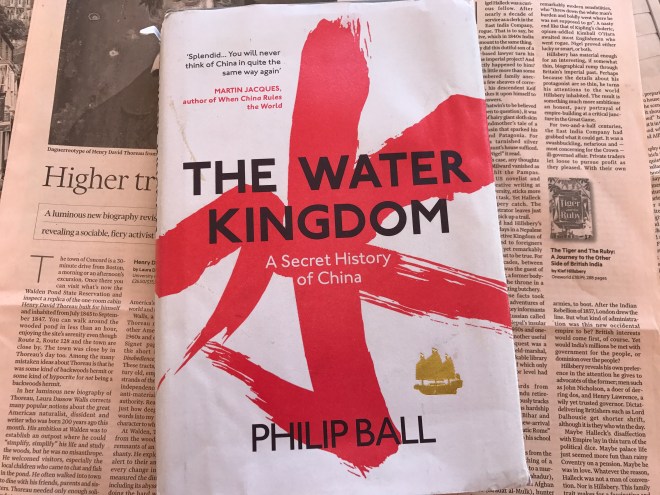
FullSizeRender (3)


NB: Also published on Frontierblog

Science writer David Ball has written an excellent book on the role of water in Chinese society: The Water Kingdom – A Secret History of China. The book provides an illuminating history of Chinese society’s unique and often turbulent relationship with water, from ancient times to the immense water challenges China is facing today.

Of course water has played a fundamental role in all human life throughout history, But fundamental geographical differences mean that water has not only played a different role in the development of Chinese compared to Western civilisation, but also that water as a concept is viewed through a different lense altogether.

Some of the key geographic differences are that:

  • While ancient European civilisation was concentrated along the coastal strips circling an enclosed sea (the Mediterranean), the ancient (as well as contemporary) Chinese civilisation had a more central than peripheral location – hence the Middle Kingdom – circled by the open ocean and barbarian lands.
  • Europe’s coastline is fragmented and indented, making navigation easy, guided by landmarks. Ships could travel long distances by hugging the coastline, and even if land was not visible ships would never be that far from a shore. In contrast China has a comparatively featureless east coast pointing out towards the trackless Pacific – making oceanic enterprises a less attractive business proposition (the ocean-going voyages of Admiral Zheng He in the early 15th century being a notable exception).
  • Thus, while Europe (stated in slightly simplified terms) developed as an oceanic civilisation (first the Mediterranean, then the Atlantic), China developed as a river-based civilisation. Its relationship to water was not primarily with the ocean, but its two great rivers; the Yellow river and the Yangtze.

The two great rivers have defined Chinese civilisation. They have served as sources for national myths, inspiration for philosophy and art, theatres of war, communication channels, transport routes – particularly for shipments of grain tribute from the regions to the capital, territorial barriers, purveyors of natural disasters, and of course as water sources for China’s agriculture, industry and cities.

The Yellow river has traditionally been designated as the cradle of the Chinese civilisation. “When the Yellow River is at peace, the nation is at peace,” runs an old saying attributed to the ancient leader the Great Yü, famed for his introduction of flood controls late in the third millenium BC. What the saying reveals is that the relationship between river and nation has often been a turbulent one.

The Yellow River has both provided the Chinese people with their livelihood, and often swiftly taking it away again. Although most large rivers are prone to flood, the extremity of the two great Chinese rivers are of a scale unlike anything known in Europe. The Yellow River has its name for a reason. Its waters are rich in China’s famous “yellow earth” from the Mongolian deserts, giving its water a higher density of solids than in almost all rivers in the world – as much as 300 grams of sediment per kilogram of water. As the river flows east, some of the sediment settles onto the riverbed and gradually raises it higher. When flood season arrives the waters are prone to overrun the banks. Since time immemorial the Chinese people have combated the flooding threat by constructing dykes of mud and rocks. However, as the riverbed rose so did the dykes, until the river itself was running like an aqueduct up to 15 meters above the surrounding landscape. When a breach eventually occured, the inevitable flood was all the more catastrophic. Yet, despite these obvious dangers it was precisely because of the river’s fertile sediments that the floodplain was so alluring to farmers.

In big floods millions of people could perish, and the river would often subsequently permanently alter its course by up to several hundred kilometres. That explains why the Yellow River is also often referred to as China’s Sorrow. 

Hydraulic Despotism 

China’s quest to conquer nature and mend the great rivers to man’s needs took on new proportions with the advent of scientific communism. But this was not a new phenomenon. As Ball’s account details both the Yellow River and the Yangtze had to a large extent been artificial ecosystems since the time of the Great Yü, created by nature but altered by man. Main portions of the Grand Canal (2350 kilometres in all) were already completed by 611 CE. 5,5 million workers were conscripted for the gargantuan construction task.

Ball has an interesting discussion on the idea of hydraulic despotism – a fusion of the terms Oriental despotism and hydraulic civilisation. The term oriental despotism was first coined by Nicolas Boulanger in his 1763 book on The Origin and Progress of Despotism. He asserted that revolutions of nature such as floods both destroyed nations and subsequently became the legislators of renewed society. Max Weber argued that rivers were the essential component of political power throughout Asia and the Middle East: “The water question conditioned the existence of the bureaucracy, the compulsory service of the dependent classes, and the dependence of the subject classes upon the functioning of the bureaucracy of the king.” German-American Sinologist and Marxist historian Karl Wittfogel built further on these ideas in the 1950s, with his theory that oriental despotism was founded on hydraulic civilisation. He argued that, “it was the task imposed by a precarious water situation that stimulated man to develop hydraulic methods of social control.” Whereas European empires were built by acquiring land, in China control of the rivers and mobilization of vast manpower was paramount to make the land productive. Karl Marx argued that only a centralizing power of government could manage this task in China.

So, was hydraulic despotism inevitable in China? Wittfogel’s theory has gone out of fashion. But it has never gone away completely. Probably because it retains a significant intuitive appeal. As most good theories it is simplified but elegant.

Mao vs Nature

If hydraulic despotism was perhaps not inevitable in China it was certainly possible, as nobody demonstrated with greater effect than Mao Zedong. In 1952 the Great Helmsman announced that “Work on the Yellow River must be done well.” With this banal slogan slogan so typical of Mao, he launched one of the most ambitious projects in the young People’s Republic. A flood control programme that included rebuilding and reinforcement of 1 800 kilometres of dykes along with 46 dams.

Mao held an unlimited belief in Communist Man’s ability to conquer nature. However, the quality of the work did not always match the quantity. Between the 1950s and 1990 more than 80 000 dams were built on China’s rivers. Many were erected hastily and constructed poorly. Still, Ball does not want to characterize the massive hydro-engineering projects of the Mao era as an abject failure. If the practical execution may often have fallen short, Ball argues that the principles behind the dam construction have been largely sound. After all, Mao simply continued, if on a larger scale, an interwar policy programme actively supported by international organisations.

Still, it it is not hard to find individual case studies of Communism at its worst. The Sanmenxia dam is one. The biggest dam on the Yelow River. Construction started in 1957 with the assistance of Soviet engineers. The claim was that the dam would retain silt and thus avoid the old problem of a rising riverbed downstream. It was said that the Yellow River would be yellow no more, and an ancient prophecy was invoked: “When a sage appears, the river will run clear” (which in popular usage had the perhaps more fitting meaning “when hell freezes over”). The claim was absurd. The Soviet technical experts left in 1960 due to the cooling relations between the two Communist powers. What was harder to get rid of was the silt. It could not be magically spelled away, but had to go somewhere. It soon accumulated against the dam wall at an alarming rate, so much so that by 1962 the dam’s capacity was halved. The silt had to be removed from the dam after all. The original goal of silt retention had to be largely abandoned. And so much water had to be allowed to pass directly through the dam wall that the hydroelectric capacity of the dam proved to be barely five percent of original estimates. For this failure, 280 000 peasants had to be forcibly resettled.

In an interesting exhibit of centralized vs local Ball notes that the river management success stories have more often been found in the mundane, low tech but capital-intensive small-scale projects at the local level. But seeing like a state does, the People’s Republic’s ambitions has usually veered towars grandiose prestige projects like Sanmenxia.

Will China run out of water? 

Ball ends his book on a disquieting note. China faces two big water-related problems:

  1. There is not enough water to go round, and
  2. Much of China’s water is often so foul that no one can use it anyway.

Is there a solution? Not necessarily. At least not yet. When the Yellow River stopped 650 kilometres short of the Boai Sea for 226 days in 1997, it served as a grave warning. Ball cites hydrology specialist Alistair Borthwick who says that: “it appears that the Lower Yellow River’s ability to meet its ecosystem and socio-economic requirements is exhausted.” China’s water resources already fall short of the country’s needs by 40 billion tonnes a year, predicted to rise to 58 billion by 2020. China’s Ministry of Water Resources predicts there will be a serious water crisis by 2030.

One big problem is that state guarantees of water supply to rural areas has removed incentives to improve irrigation efficiency. Agriculture accounts for two thirds of China’s water use, and 70 percent of the country’s food relies on irrigation. As the Chinese eat increasingly eat more meat and farmers prefer to grow high-value but water-intensive crops such as fruits and nuts rather than grain and potatoes, the water problem has gotten continuously worse.

The scale of China’s water challenges is illustrated by the gigantic South-North Water Transfer Project. A modern equivalent to the Grand Canal the project aims to transport 45 billion cubic metres of fresh water annually from the Yangtze basin in the south to the North China Plain along three separate channels each over 1 000 kilometres long. The central and eastern routes are now in operation. So far the total cost has surpassed 79 billion dollars, more than twice the cost of the Three Gorges Dam. In what Ball rightly describes as an extraordinary subversion of geography, both the eastern and central routes require the water to be transported through tunnels under(!) the Yellow River. A feat of engineering even Mao would be proud of, but which at the same time reveals the fragility of the system.

The water problem does not only make the infrastructure fragile, but is also a source of fragility for the entire Chinese political system. Ball makes a convincing argument that the Chinese people may be more liable to revolt over a practical question such as lack of water, than a more abstract lack of political rights. Indeed, back in 2005 there was already 1 000 environmental protests every week. The Chinese leadership is well aware of the challenge they are facing. Work on the Yellow River must be done well.

The Tragedy of Lofoten’s Tourism Commons

Quite a lot of Norway coverage in the FT this weekend.

And an excellent longer read by Nordic correspondent Richard Milne on the “Battle for Norway’s Soul,” over the controversial question if Norway should open up for oil exploration in Lofoten, Vesterålen and Senja (LoVeSe) or leave the hypothetical 1,3 billion barrels of oil untouched under the surface.

The article gives a good summary of the warring viewpoints in what is really a quadripartite conflict putting the interests of the oil industry, the fishing industry and the tourism sector against each other, while all three industries also face stiff resistance from the environmentalist movement.

I will not take sides in the oil question in this post, but only have some brief comments on the tourism question. The tourism sector in Northern Norway suffers from an obvious tragedy of the commons, with already very visible negative effects; high environmental costs yet low economic benefits.

  • There has without a doubt been quite a quality improvement in the Norwegian hospitality sector in recent years, with new accomodation and dining supply offering more than the typical Norwegian bare minimum service. Still, the high end of the Norwegian hospitality sector remains woefully underdeveloped. If Lofoten had been in Sweden and run by Swedes the region’s tourism income would probably have been twice as high, at least.
  • As the 80 year old artist/environmentalist Tor Esaissen sensibly points out Lofoten tourism cannot and should not be a mass market product. Even though it is in some way in conflict with egalitarian Norwegian values, Lofoten must be an expensive high-end tourism product. The product is based on its raw natural beauty. Too large tourist crowds will destroy that appeal.
  • The ideas of a tourist tax, maximum visitor quotas and/or minimum spending requirements are therefore radical but interesting, and worthy of serious consideration.
  • It obviously makes very little sense to have large numbers of camping tourists, who quite literally cover the landscape in shit, while leaving little money behind. The number of visitors allowed to camp in their cars or out in the open for free should be severly limited.
  • Norway must capitalise on the rising trend in avantgarde/explorer/“self realisation” tourism which generates high revenue per tourist while limiting the number of visitors. That is a way more sustainable route than continuing to let in hordes of visitors who spend minimal amounts of money. In order to achieve this there must of course be a product and service offering for visitors to spend money on, from high-end cruise travel, boutique hotels, experiences and exploration activities. In this domain the Norwegian hospitality sector probably still has much to learn from leading destinations, even though there has been a marked improvement in recent years.


Macron’s Shipyard Nationalisation

In theory Emmanuel Macron was elected on a pro-business platform including pledges to reform France’s labour market, cut public spending, reduce taxes and turn France into a “startup nation.”

In practice, however, one of the Jupiterian president’s first economic policy actions has been to nationalise a shipyard, STX France, to prevent it from going to Italian hands.

Italy’s state-owned Fincantieri shipyard earlier this year agreed to acquire 2/3 of the French shipyard, after the Korean parent STX collapsed last year. When the Italians balked to accept the offer of a 50/50 ownership split, Macron exercised France’s pre-emption rights to acquire the whole company.

So what does this mean? Is the nationalisation to be viewed as a non-ideological act of Gaullist pragmatism? Or is Macron really a Mitterand disguised in Rothschild clothing?

It seems the French government is trying to downplay the implications of the nationalistation, with economy minister Bruno Le Maire insisting that; “The pre-emption decision is temporary and should give us the time to negotiate in the best conditions.”

Yet at the same time Le Maire stated that the nationalisation had a “single objective”, to “defend France’s strategic interests in shipbuilding.”

We are thus led to believe that the nationalisation is both 1) temporary and 2) strategic, which can sound like a contradiction in terms.

Perhaps the French state already have other potential buyers up their sleeve, and that a sale of the shipyard will indeed find place within a short time frame. If not, the French state’s dirigiste handling of the affair may dissuade other potential acquireres from entering the fray, presuming that they are deemed politically acceptable owners by the French government in the first place.

In the meantime the Macron government has achieved to:

  1. Raise severe questions over the Macron government’s real business agenda.
  2. Hurt Franco-Italian relations
  3. Raise barriers for intra-EU mergers and acquisitions.

At the same time the nationalisation shows that Macron does not hesitate from taking strong and radical actions, that may not lend themselves to easy interpretation within the framework of a left to right political axis.

So far the new French president may be more Mercurial than Jupiterian